
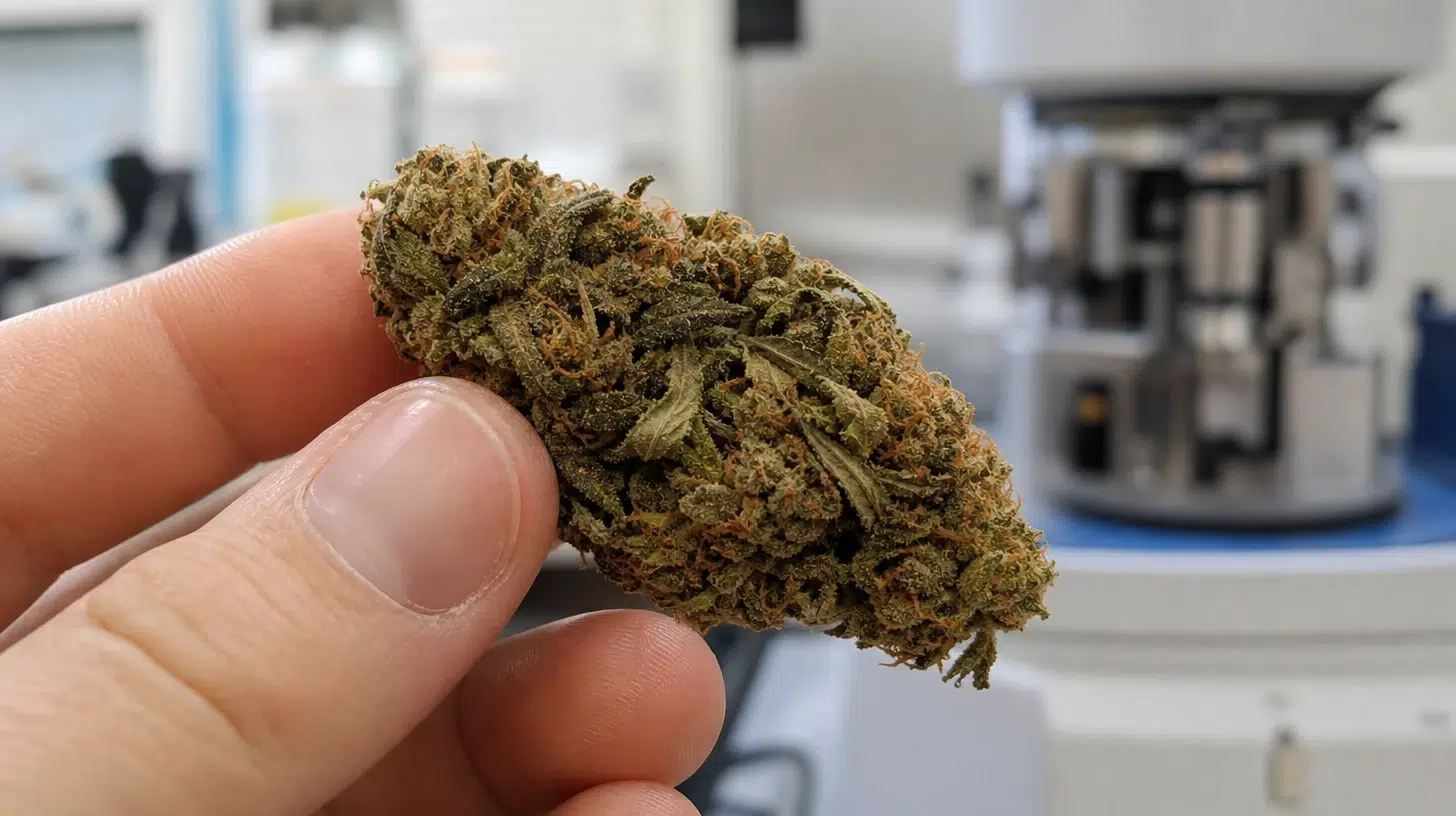

Advances in analytical techniques have paved the way for new methods in agricultural product traceability . Among these, isotopic analysis is generating increasing interest, particularly for cannabis . This technology promises to authenticate geographical origin or reveal the cultivation practices associated with a product. But to what extent can this approach truly establish the provenance of cannabis? Are isotopic signatures reliable enough to address the economic, health, and legal challenges facing the industry?
Fundamental principles of isotopic analysis
Isotopic analysis relies on the precise measurement of the ratio between different stable isotopes within a chemical element present in a sample. For cannabis, the most studied elements are carbon (13C/12C) and nitrogen (15N/14N). Their proportions vary depending on the environment in which the plant grew.
These differences result from numerous factors such as soil type, climate, and the source of fertilizers used. Thus, each region and each cultivation method leaves a unique " isotopic signature " on the plant, providing a kind of chemical identity. For those seeking a cannabinoid-free wellness alternative, the CB2 Complex offers an innovative solution. This principle is already used in other agricultural sectors to prove theorigin of wine or honey, for example.
How does the measurement of isotopic ratios work?
The process involves isolating and then precisely quantifying the isotopic ratios specific to certain elements. This is achieved using gas chromatography coupled with mass spectrometry, two complementary technologies that allow for the identification of the different atomic variants present.
After extraction and separation of the target compounds, mass spectrometry determines the precise ratio between the isotopes of interest, thus producing a characteristic profile. This technique also allows for the detection/quantification of THC or other cannabinoids, thereby meeting the needs of drug screening orbotanical identification.
Common applications in the agricultural sector
The use ofisotopic analysis extends far beyond the cannabis industry. Many high-end food products use it to guarantee their traceability. Coffee, rice, oils , and fruits all benefit from this sophisticated control, which is essential to limit fraud or origin substitution.
The reliability of an isotopic signature , however, depends on the richness of databases covering the diversity of terroirs and their environmental characteristics. Without a solid reference framework, linking a profile to a region remains difficult.
Isotopic signatures of cannabis: potential and current limitations
Applyingisotopic analysis to cannabis traceability offers promising prospects, both for the legal sector and for combating illicit trafficking. To stay informed about developments and news in the sector, consult our dedicated CBD blog. However, several obstacles currently prevent a definitive attribution ofgeographical origin based solely on isotopic profile.
Factors such as the local environment and external inputs (water, fertilizers, artificial light) strongly influence the results. Therefore, defining a truly robust regional marker that is valid in all situations remains challenging.
Genetic diversity and agronomic variability
Cannabis of genetic diversity, which directly influences its physiology and therefore its isotopic signatures. Two plants from different lineages but grown under identical conditions can produce divergent isotopic profiles.
Conversely, the same strain grown under contrasting nutritional regimes, indoors or outdoors, will show different results. Controlling these factors remains essential to refining the reliability ofgeographic attribution by isotopic analysis.
Influence of cultivation practices on the isotopic ratio
The use ofsynthetic or organic fertilizers directly affects the nitrogen isotope ratio (15n/14n). Similarly, the choice between well water and surface water alters the oxygen isotope composition (18o/16o), complicating the precise localization of a crop. These parameters must be carefully documented to correctly interpret the results.
The use of controlled-spectrum lamps or enriched CO₂ also disrupts the traditional reading of carbon ratios. This makes it difficult to establish universal reference bases, especially in emerging producing regions lacking data.
Analytical tools and scientific protocols used
To ensure the accuracy of analyses, laboratories often combine several techniques when examining a cannabis. Here are some commonly used methods:
- Gas chromatography to separate target molecules prior to analysis.
- Mass spectrometry to identify and quantify specific isotopes.
- Comparison with regional isotopic reference values from field sampling campaigns.
- Statistical corrections to neutralize the effect of agricultural practices or industrial processing.
Institutions are gradually developing appropriate protocols to eliminate potential biases and define margins of error. In advanced approaches,isotopic analysis is integrated with other methods such asDNA botanical identification or macroscopic morphological characterization.
Comparative illustration of analytical methods
Various tools can be used to differentiate cannabis batches based on their presumed origin. The following table summarizes their main characteristics, advantages, and limitations:
| Method | Principle | Advantage | Limit |
|---|---|---|---|
| Isotopic analysis | Measurement of stable ratios (13c/12c, 15n/14n) associated with the environment | Non-destructive, informative about the origin and cultivation method | Requires comprehensive regional databases, influence of agricultural practices |
| Chromatography – Spectrometry | Separation and precise identification of molecular components | Enables the detection/quantification of THC or other active compounds | Informative only about the instantaneous chemical composition |
| DNA analysis/genotyping | Identification of the botanical variety or lineage | Distinctive for distinguishing hybrid/landrace strains | Indicates genetics, not necessarily actual geographic origin |
No single protocol is infallible. The judicious combination of several methods strengthens the robustness of the approach but requires time, budget, and multidisciplinary expertise.
Future prospects and remaining challenges
The development of global isotopic databases and advanced predictive models will be crucial for improving cannabis traceability. Ultimately, it could become possible to integrate these analyses into a global origin certification for the legal sector, similar to those that exist for wine or specialty coffee.
International collaboration will be essential to standardize the collection, archiving, and sharing of analytical repositories. In the meantime, caution remains necessary when assigning a certified geographical origin to a batch of cannabis, in such an evolving and sensitive context.
What is an isotopic signature and why is it valuable in cannabis traceability?
An isotopic signature is the specific profile formed by measuring the ratios between stable isotopes (for example, 13c/12c or 15n/14n) detected in a given sample. This identification makes it possible to associate certain chemical properties with a particular terroir or cultivation practices. For cannabis traceability, it helps to validate the geographical origin, verify compliance with legal or commercial standards, and, in some cases, combat fraud.
- Objective identification based on fundamental chemistry
- Potential for batch authentication in the legal supply chain
What factors can distort the interpretation of the isotopic ratio in cannabis?
Several variables can modify isotopic profiles independently of location: the use of synthetic or organic fertilizers, the type of irrigation, the transition to indoor cultivation under lights, or the intentional modification of the atmosphere around the plants (CO₂ injection). These practices alter the natural chemistry and can blur the link between isotopic signature and geographic origin.
- Soil types/fertilizers
- Irrigation water management
- Genetic variety and cultivation method
Can isotopic analysis definitively determine the geographical origin of cannabis today?
Currently, isotopic analysis of cannabis cannot definitively establish its geographical origin in all circumstances. The lack of comprehensive databases, the diversity of agricultural practices, and the mobility of varieties reduce the method's probative value. Combining it with other traceability techniques is necessary to strengthen the validity of the findings.
- Connection with other analyses (DNA, field prospecting)
- Need for comprehensive geographical reference data
- Sensitivity to technical changes in culture
What are the next steps to ensure reliable cannabis traceability using the isotopic approach?
Progress depends on enriching isotopic databases, harmonizing sampling protocols, and combining this information with additional botanical or environmental data. Strengthening cooperation between laboratories, research institutes, and industry stakeholders will ultimately lead to the development of robust reference frameworks, a prerequisite for reliable global application.
- Networking of specialized laboratories
- Systematic collection of samples across the producing areas
- Development of cross-cutting indicators (DNA analyses, environmental analyses)

Co-founder of CBD.fr
Julien Cordobes is the editor of CBD.fr. Born in 1978 in the Paris region, he first trained in e-commerce before turning to natural health approaches, a dual perspective that now structures his way of writing about cannabidiol: reading the scientific literature as it is, without hardening the conclusions, and presenting it in a language that everyone understands.
He discovered CBD at a time when the French market was developing faster than the information available to it. He acquired CBD.fr in 2022 and then took on editorial responsibility for the blog. Since then, he has published numerous articles covering the daily use of CBD, the interpretation of laboratory analyses, the evolution of the legal framework, and precautions for use.


