
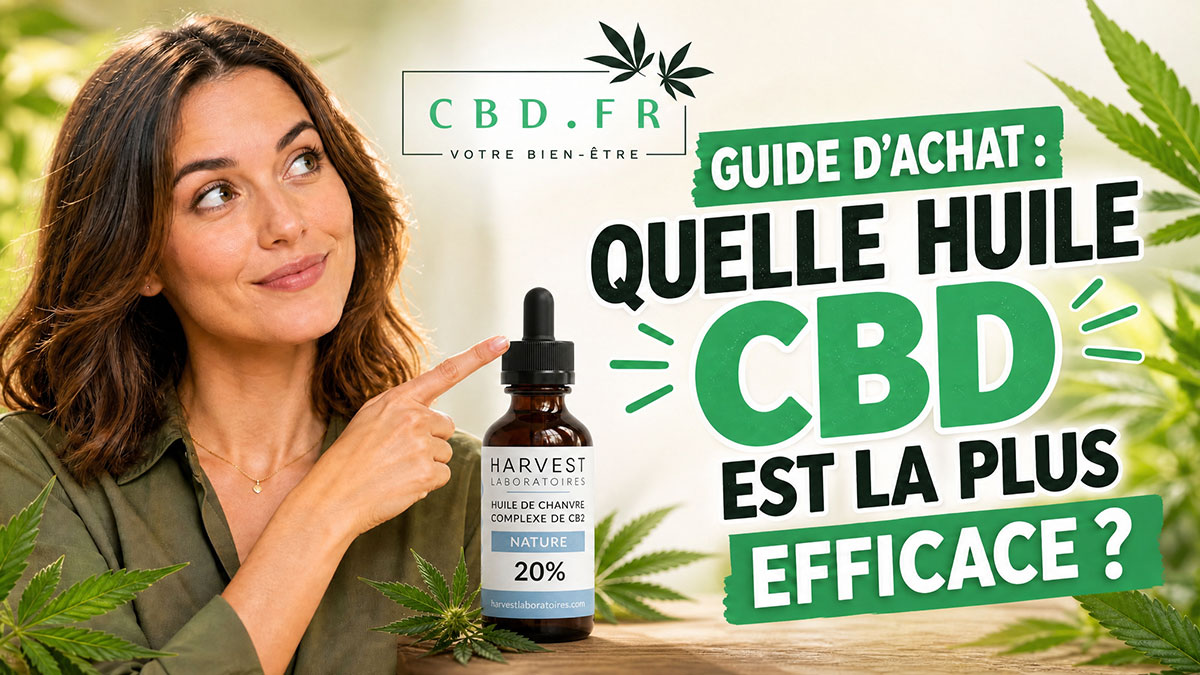

CBD oil is by far the most widely used form in the cannabidiol world—and probably the most diverse. Concentrations from 5% to 40%, different spectra, various carrier oils, multiple extraction methods, prices ranging from €15 to €200… At first glance, it's a maze. In reality, there's a fairly simple framework to navigate it, provided you know what to look for. In this guide, we give you all the objective technical criteria to compare two oils and make an informed choice based on your needs.
⚠️ Important: CBD is not a medicine. It is sold as a supplement, without any authorized health claims. If you are considering using it for health reasons, speak to a qualified healthcare professional.
Concentration: the most visible criterion (but not the most important)
This is what most consumers look at first — and understandably so, because it's what's prominently displayed on the label: 5%, 10%, 20%, 30%, sometimes 40%. But understanding what these percentages actually mean makes all the difference.
The concentration indicates the amount of CBD contained in the bottle. A 10ml bottle at 10% concentration contains 1000mg of CBD. The same bottle at 20% concentration contains 2000mg. Therefore, a more concentrated oil isn't inherently "more effective" at the same volume—it simply contains more CBD per drop, allowing you to adjust your dosage and pay less per milligram.
In practical terms: if you're a beginner, a 5% or 10% oil allows you to precisely control the dosage and observe how you feel without the risk of overdose. If you already know your needs and consume several drops per day, a more concentrated oil (15% to 30%) is more economical and convenient (fewer drops to take). Oils of 40% and above are intended for very experienced users; they are also more viscous and have a stronger taste.
The best approach is to compare the price per milligram of CBD between two products, not the price per bottle. A bottle costing €80 containing 3000 mg of CBD works out to 2.67 cents per mg; another costing €50 containing 1000 mg works out to 5 cents per mg. For equivalent quality, the first is almost twice as cheap.
Full spectrum, broad spectrum, isolate: the difference that changes everything
This is the most crucial factor in understanding what you're really buying, and the one most guides explain poorly. There are three main categories of CBD oils.
The full spectrum
This oil contains all the compounds naturally present in the hemp plant: CBD, of course, but also other minor cannabinoids (CBG, CBC, CBN, traces of THC below the European legal threshold of 0.3%), terpenes (limonene, myrcene, pinene, linalool, caryophyllene, etc.), and flavonoids. This complete profile allows for the entourage effect—the synergy between molecules that makes the whole more active than each compound taken individually. For most regular users, this is the preferred format because it preserves the plant's natural profile.
The broad spectrum
It's an interesting compromise. The oil contains all the cannabinoids and terpenes of the plant, except for THC, which has been removed through an additional purification process. You therefore retain much of the entourage effect while eliminating the (already very low) risk of detection by a saliva or hair test. This is particularly recommended for people subject to professional controls (drivers, certain regulated professions) or simply for those who want zero THC for personal reasons.
CBD isolate
Isolate is 99% pure CBD that has been crystallized and then diluted in a carrier oil. No other cannabinoids, no terpenes, no flavonoids—only the cannabidiol molecule. It's the "cleanest" and most predictable option: no hemp smell or taste, very precise dosage, and no risk of psychoactive effects (even the slightest). On the other hand, you don't benefit from the entourage effect. Isolate is preferred by those looking for a neutral product or who have a particular sensitivity to other hemp compounds.
If you are hesitating between the three without having any particular constraints: start with a full spectrum — it is the most scientifically documented format, and the one that best exploits the potential of the plant.
Extraction method: CO₂, ethanol, solvents
The method used to extract CBD from the hemp plant determines both the purity of the final product and the preservation of the active compounds. Three main techniques coexist on the market, and they are not all equal.
Supercritical CO₂ extraction is now the industry standard. Carbon dioxide, under high pressure and controlled temperature, behaves as both a gas and a liquid, allowing for the selective extraction of cannabinoids and terpenes without leaving any solvent residue. The final product is clean, the aromatic profile is preserved, and the method is environmentally friendly. It is the preferred option without hesitation. The drawback: expensive equipment, therefore a higher cost price that is passed on to the finished product.
Ethanol extraction is a good alternative, provided it is performed correctly. Food-grade ethanol effectively dissolves cannabinoids, but the post-extraction purification step is crucial to eliminate any residue. A properly produced ethanol oil can be of excellent quality; a poorly purified oil may contain problematic traces. This is precisely why a certificate of analysis is essential (see below).
Extractionusing hydrocarbon solvents (butane, propane, hexane) is primarily used in the production of concentrates. For oils intended for oral consumption, this method should be avoided unless the producer can demonstrate the complete absence of residues in their certificate of analysis. In practice, for the European consumer market, CO₂ or ethanol extraction is preferable.
Our selection of CBD oils on cbd.fr comes exclusively from controlled CO₂ or ethanol extractions, with systematic laboratory analyses.
Carrier oil: MCT, hemp, olive, which one to choose?
CBD is a fat-soluble molecule, meaning it is absorbed through fats. This is why CBD oils are oils: pure cannabidiol, in crystalline form or as an extract, is dissolved in a carrier oil that acts as both a vehicle and an absorption agent. This carrier oil has a significant impact on the final product in three key areas: bioavailability, taste, and shelf life.
MCT (Medium Chain Triglyceride) oil , typically extracted from coconut, is the most widely used in premium CBD oils today. Its medium-chain triglycerides are absorbed directly by the liver, promoting rapid CBD absorption. It has a nearly neutral taste, excellent shelf life, and is compatible with almost everyone (except those with a specific coconut allergy). It's the most versatile default choice.
Hemp seed oil yields a consistent, all-hemp product with a light green color and a more pronounced (grassy, sometimes nutty) flavor. It also offers an interesting nutritional profile (omega-3 and omega-6 fatty acids). The drawback is its faster oxidation rate, which reduces its shelf life after opening.
Extra virgin olive oil is a traditional option, especially in artisanal oils. It has a good nutritional profile and characteristic taste, but its texture is more viscous and its shelf life is less stable than that of MCT oil. It's a good choice if you appreciate the "all-natural" aspect.
Other oils exist (sunflower, sesame, flaxseed, etc.) but remain marginal. The decisive criterion is not so much the type of oil as its quality (cold-pressed, organic, fresh). When in doubt, MCT oil is statistically the best compromise between bioavailability, shelf life, and taste.
The certificate of analysis: the non-negotiable truth test
If there's one essential requirement before buying CBD oil, it's this: a Certificate of Analysis (COA). This document, issued by an independent laboratory, verifies the actual contents of the product. Without a certificate, you have absolutely no guarantee that what's written on the label matches what's in the bottle.
A reliable certificate of analysis will indicate at a minimum:
- The complete cannabinoid profile : exact percentage of CBD, THC, and minor cannabinoids (CBG, CBN, CBC, CBDA…)
- The terpene profile for full-spectrum and broad-spectrum oils
- Theabsence of pesticides (list of molecules tested for and results)
- Theabsence of heavy metals (lead, cadmium, mercury, arsenic — hemp is an “accumulator” plant that captures metals from the soil)
- Theabsence of residual solvents related to the extraction
- Theabsence of microbiological contamination (molds, yeasts, bacteria)
- The name of the independent laboratory, the date of analysis, and the product batch number
A seller who refuses to provide this certificate, or who sends you a vague document such as "internal analyses," is a major red flag. Conversely, a reputable seller displays the certificates on the product pages or sends them upon request, batch by batch. On cbd.fr, each product comes with its complete certificate of analysis—this has been our standard since the site's inception.
The origin of hemp and traceability
Where does the hemp used to produce the oil come from? This question may seem secondary, but it is actually fundamental because it determines the purity of the final product. Hemp is a bioaccumulating : it absorbs everything in its soil, including heavy metals. This is precisely why it is used in phytoremediation to decontaminate polluted soils. In practical terms, hemp grown on industrially contaminated soil will produce an oil containing those same contaminants—even if the extraction method is perfect.
The best current sources are hemp grown in Europe (France, Switzerland, Italy, the Netherlands, Czech Republic) in clean agricultural areas, ideally certified organic. European regulations on pesticides are among the strictest in the world, and crop traceability is generally good. American hemp (Colorado, Oregon, Kentucky) is also of high quality, provided it has the corresponding certification. Avoid hemp of unclear or undocumented Asian origin.
On the label or product information sheet, you should be able to find: the country of origin of the hemp, ideally the cultivation method (organic, conventional, sustainable, etc.), and the production date. A transparent producer will provide this information directly.
Bioavailability: why sublingual administration is preferred
Bioavailability is the percentage of CBD actually absorbed by your body compared to the ingested dose. It's a major parameter often overlooked in buying guides because it depends less on the product itself than on how you consume it.
Sublingual administration involves placing a few drops under the tongue and leaving them there for 60 to 90 seconds before swallowing. The highly vascularized mucous membranes in this area allow CBD to pass directly into the bloodstream, bypassing first-pass metabolism in the liver. Bioavailability is estimated at 13-35% according to studies—making it the most efficient route of administration for an oil, and by far the most scientifically studied.
Conversely, if you swallow the oil directly (or mix it with food), it goes through digestion. The liver will metabolize a large portion of the CBD via cytochrome P450 enzymes before it reaches the bloodstream—this is the first-pass hepatic effect. Bioavailability then drops to 4-20%. You get a delayed effect (1 to 2 hours compared to 15-30 minutes sublingually) and a more diluted one.
To optimize absorption:
- Prefer sublingual administration on an empty stomach or between meals.
- Keep the oil under your tongue for at least 60 seconds before swallowing.
- Combine with a light source of fat within the hour before or after (a spoonful of olive oil, cheese, nuts) — CBD's fat solubility benefits from this environment
Which oil best suits your consumer profile?
Rather than simply listing "the best oils," here's a guide based on your profile. Use it to identify with your own profile and make your choice.
You're a beginner and you want to discover CBD
Start with a full-spectrum oil, 5-10%concentration, MCT base, CO₂ extraction. You'll get the full richness of hemp's natural profile, an easy-to-adjust dosage (1 drop = approximately 2.5 to 5 mg of CBD depending on the concentration), and a reasonable investment to test your tolerance and how you feel. Test it for 2-3 weeks before increasing the concentration.
Are you looking for a daily routine for stress management and sleep quality?
A full-spectrum oil with 10 to 20% concentration is probably the best compromise between dosage, cost, and the entourage effect. Split the doses (one in the morning, one in the early evening, for example) and observe the results over several weeks. For sleep- specifically, also explore our dedicated CBD and sleep.
You are an experienced user with significant needs
Aim for concentrations of 20 to 40%, always full spectrum if there are no THC restrictions. Major long-term economic advantage (the price per milligram drops considerably), convenience (few drops per dose), stronger taste which may require an adjustment period.
You are subject to professional checks (driver, security, etc.)
Opt for a broad-spectrum, THC-free or an isolate. Even if the THC content of a full-spectrum oil remains below the legal limit (0.3%), very regular use at high doses can theoretically leave detectable traces on some tests. Broad-spectrum oils eliminate this risk while preserving most of the entourage effect.
Are you sensitive to strong flavors or are you looking for a neutral product?
Isolatein an MCT oil is your friend: virtually tasteless, perfectly dosable, and without the hemp odor. You'll lose the entourage effect, but you'll gain in comfort during daily use.
The price: how much should a quality oil cost?
The price of CBD oil varies primarily based on three factors: the concentration (i.e., the amount of CBD), the extraction method (CO₂ being more expensive), and the origin of the hemp (organic European hemp being more expensive than conventional Asian hemp). For reference, here are the reasonable price ranges for the French market in 2026.
A good quality, full-spectrum, CO₂-extracted 10ml bottle of 5% CBD oil (500mg) should cost between €25 and €45. At 10% (1000mg), the price range is between €40 and €75. At 20% (2000mg), between €65 and €130. At 30% (3000mg), between €90 and €180.
Be wary of prices below these ranges: a 10% oil sold for €15 has either lied about its actual concentration or uses very low-quality raw materials (untraceable hemp, extraction with questionable solvents). Above these prices, you're probably paying more for the brand than the product. To make a rational comparison, always calculate the price per milligram of CBD (price of the bottle ÷ mg of total CBD) — this is the only metric that allows you to objectively compare different oils.
For those on a tight budget who still want quality, check out our cheap CBD, where we bring together the best quality/price ratios from the catalogue.
FAQ
How many drops of CBD oil should I take?
There is no universal dose, and no one should give you a precise figure without knowing your individual profile. The principle is to start with 2-3 drops per dose, observe for a few days, then adjust gradually. One drop typically contains between 2.5 mg (5% oil) and 15 mg (30% oil) of CBD.
How long before I feel an effect?
When taken sublingually, the effect is generally felt within 15 to 45 minutes and lasts 4 to 6 hours. When taken orally (swallowed), the peak effect takes 60 to 120 minutes, with a longer duration (6 to 8 hours) but less intensity.
How long can CBD oil be stored?
A properly formulated oil can be stored for 12 to 24 months unopened, and 3 to 6 months after opening if kept away from light (in a tinted bottle) and at a stable room temperature. Avoid heat, direct sunlight, and humidity, which degrade cannabinoids and terpenes.
Is CBD legal in France?
Yes, provided that the final product contains less than 0.3% THC (the European threshold) and that the CBD comes from authorized varieties. All products sold on cbd.fr strictly comply with these regulations.
Can CBD interact with my medications?
Yes. CBD is metabolized by cytochrome P450 enzymes in the liver, like many medications. If you are taking any chronic medication (anticoagulants, antiepileptics, immunosuppressants, certain psychotropic drugs, etc.), talk to your doctor before starting CBD. See our article on CBD and medications.
What is the difference between CBD oil and hemp seed oil?
There's no connection. Hemp seed oil is a food-grade oil pressed from the seeds, and it contains no CBD (the seeds contain virtually none). CBD oil is a preparation made from an extract of the plant (flowers and leaves), rich in cannabidiol, diluted in a carrier oil. Be wary of products that exploit this confusion at incredibly low prices.
In summary: the checklist for making the right choice
Before buying CBD oil, always check these seven points: (1) clear concentration adapted to your profile, (2) type of spectrum (full / broad / isolate) consistent with your use, (3) documented extraction method (CO₂ or controlled ethanol), (4) quality carrier oil (MCT, hemp or olive), (5) complete and accessible certificate of analysis, (6) traceable origin of hemp (ideally European organic), (7) consistent price per milligram (neither too low nor excessive).
On cbd.fr, every oil in our catalog meets these seven criteria. To discover our other CBD-based formats, see also our CBD capsules (a convenient, tasteless alternative) and our CBD flowers.
Disclaimer: This article is for informational purposes only. CBD is not a medicine and should not replace any medical treatment. Before using it, especially if you are undergoing treatment or have a medical condition, consult a qualified healthcare professional.

Editor-in-Chief specializing in CBD
Julien, born on July 17, 1978, in the Paris region, is a prominent writer and expert in the field of CBD products. Following his studies, Julien developed a passion for natural remedies, including CBD. In 2022, he joined the CBD.fr team as an expert and regular contributor. Thanks to his scientific expertise and clear writing style, Julien helps demystify the complexities of CBD, while highlighting its benefits and potential applications through his articles and conference presentations.


