
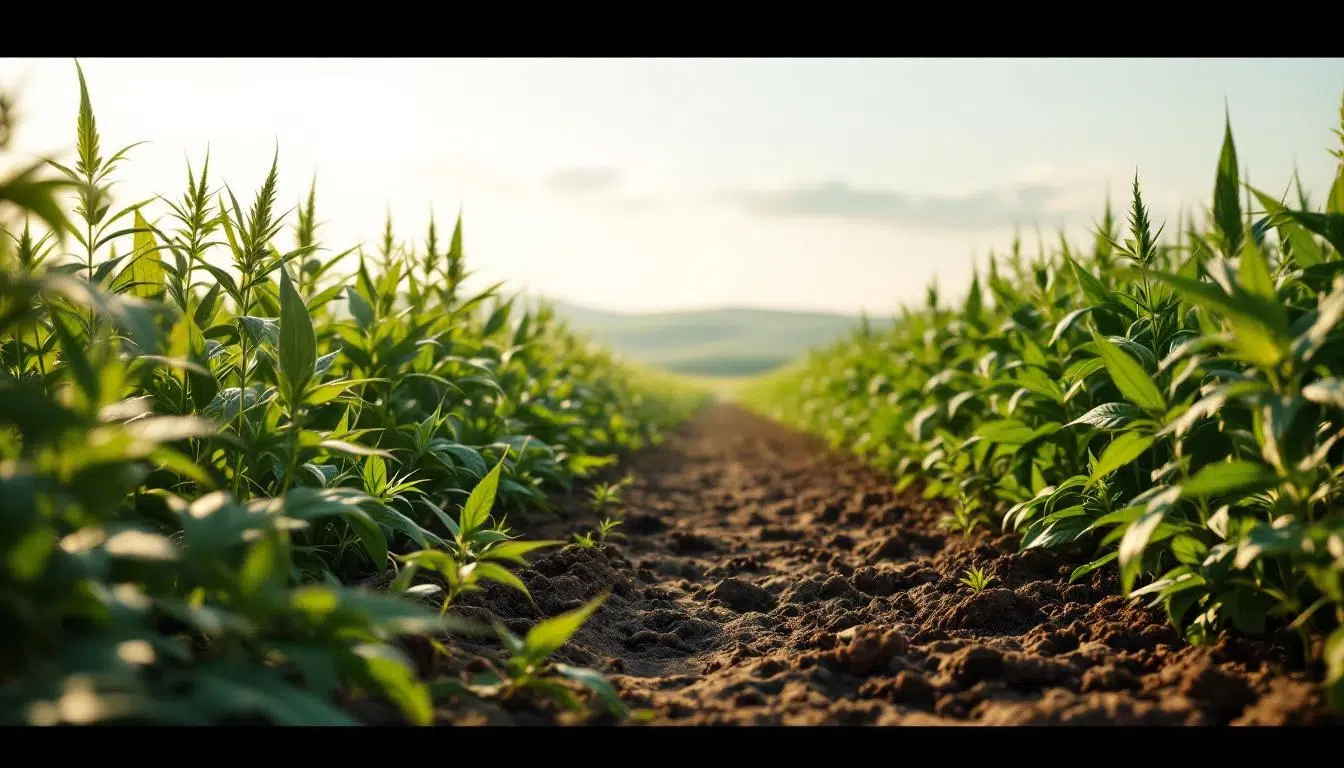

The carbon footprint of hemp is as intriguing as it is appealing, especially now that the environmental impact of agricultural crops is a major concern for both agroecologists and responsible consumers. Industrial hemp, long overshadowed by other sectors, is now regaining its rightful place thanks to its unique ecological profile. Between its CO2 sequestration, low input use , and diverse applications ranging from textiles to bio-based building materials, it's time to compare hemp with other widely cultivated crops.
What is the carbon footprint of a crop?
A carbon footprint measures all greenhouse gas emissions generated throughout a crop's life cycle. This analysis takes into account activities such as tilling ,fertilization ,water use, and post-harvest processing. Within this framework, each plant reveals a specific environmental impact based on its needs and yield per hectare.
Comparing different cultivated species quickly reveals significant variations in their contribution to carbon absorption and CO2 release into the atmosphere. This criterion proves decisive when choosing more eco-friendly raw materials for agriculture, fashion, or construction.
Hemp cultivation: a champion of ecological sobriety
Industrial hemp is distinguished by its ability to efficiently capture atmospheric carbon. Thanks to rapid growth and deep root systems, this plant fixes large quantities of CO2 from the first months of development. This phenomenon contributes to carbon storage in the soil, thus limiting its volatilization into the atmosphere.
Hemp cultivation also involves low input use . Its adaptability allows it to thrive without relying heavily on nitrogen fertilizers or pesticides, unlike many other intensive crops which have less favorable climate records . For those looking to reduce the impact of their consumption, choosing products made from locally grown, potent CBD flowers ensures a smaller carbon footprint related to raw materials.
Carbon absorption per hectare: what does science reveal?
Several studies highlight hemp's exceptional ability to absorb between 9 and 15 tonnes of CO2 per hectare during its growth phase alone. This rate significantly exceeds that of many commonly cultivated plants, reinforcing hemp among the best natural solutions for carbon sequestration.
By comparison, a typical temperate forest stores approximately 5 to 8 tons of carbon per hectare annually, while corn and wheat often only store around 2 to 4 tons. The potential of hemp therefore deserves to be highlighted from the perspective of climatology applied to agriculture. For those wishing to delve deeper into these topics, consulting specialized reports on current CBD news offers a complementary and enriching perspective.
Low input use and resilient agroecosystem
Unlike crops such as cotton or rapeseed, hemp requires little fertilizer, very few pesticides, and remains particularly water-efficient. Its hardiness significantly reduces the carbon footprint associated with soil preparation and routine pest and disease management.
In many regions, producers are finding that crop rotations including hemp actually improve soil fertility, reduce erosion, and promote local biodiversity. These indirect benefits, combined with its low direct environmental impact, reinforce the appeal of diversifying agricultural systems.
Comparison with other cultures: what are the key figures?
Analyzing the carbon footprint of hemp compared to soy, cotton, flax, or corn allows us to put its unique environmental performance. Each sector has its own specific characteristics in terms of productivity, input requirements , and the valorization of co-products. To gain a clearer understanding, here is a comparative summary with figures:
- Hemp: Absorbs 9-15 t/CO2/ha/year, limited irrigation, minimal inputs.
- Cotton: Barely 2.5 t/CO2/ha/year, high water requirement, high chemical inputs.
- Maize: 3-4 t/CO2/ha/year, strong dependence on fertilizers, mixed results depending on the area.
- Flax: 3.5-6 t/CO2/ha/year, variable adaptation, moderate use of inputs.
Based on this data, hemp emerges as one of the few crops to combine high carbon yield with low environmental impact. Its short cycle (4 to 5 months) even allows for annual doubling in some regions, amplifying its ecological productivity.
| Culture | Carbon absorption (t/CO2/ha/year) | Water requirements | Input level |
|---|---|---|---|
| Hemp | 9 – 15 | Weak | Very low |
| Cotton | ~2,5 | Very high | Pupil |
| But | 3 – 4 | AVERAGE | Pupil |
| Linen | 3,5 – 6 | AVERAGE | AVERAGE |
Hemp yield and productivity
Yield and productivity also influence the calculation of the final carbon footprint . In addition to its massive CO2 absorption , hemp provides a versatile biomass of 10 to 15 tonnes per hectare . This high yield offers a valuable resource for the textile , construction , and bio-based materials sectors .
Every part of the plant can be used: long fibers for eco-friendly clothing, hemp hurds for building insulation or granules, and seeds for food and oil.This optimization limits losses and actively contributes to reducing waste throughout the entire value chain.
Textiles, construction and bio-based materials: virtuous uses
Using hemp as the primary base for textiles and clothing helps reduce the overall carbon footprint of the apparel industry. Hemp fiber requires less water and pesticides than cotton; its mechanical processing is also less energy-intensive than some processes used in the conventional textile industry.
In the construction industry , bio-based materials derived from hemp —lightweight concrete, insulating panels, or bricks—extend CO2 storage in buildings . By permanently sequestering the carbon captured during the plant's growth, these products offer a dual ecological function: active sequestration during cultivation and passive conservation in built structures .
Long-term environmental impact
The adoption of hemp-based solutions is part of the carbon neutrality strategy pursued by the construction sector. Some hemp-based composite materials have a negative carbon footprint , meaning they store more CO2 than was emitted during their production, transport, and installation.
For consumers, choosing hemp clothing means supporting a fiber whose cultivation rivals that of linen or wool in terms of resource efficiency, but offers greater flexibility and full utilization of its agricultural output. Emerging markets are thus increasingly recognizing hemp's key role in circularity and eco-design.
Frequently asked questions about the carbon footprint of hemp and other crops
What is the main difference between the carbon footprint of hemp and that of cotton?
Hemp has a much higher carbon absorption capacity than cotton, while cotton requires significantly more water and chemical inputs. On one hectare, hemp cultivation captures up to six times more CO2, while using considerably fewer natural resources. Here is a summary:
- Higher carbon absorption per hectare for hemp
- Less water consumed
- Inputs limited to the bare minimum
| Hemp | Cotton | |
|---|---|---|
| CO2 absorption (t/ha/year) | Up to 15 | 2,5 |
| Water requirements | Weak | Very high |
Can the carbon footprint of buildings be reduced with hemp?
Hemp is widely used in the design of bio-based building materials. Its applications allow for the storage of CO2 in walls, floors, and insulation, thus offering an effective solution for reducing the overall carbon footprint of buildings. Furthermore, hemp-based products exhibit excellent durability and improve the thermal performance of homes.
- Insulating materials made from hemp shives
- Bricks and panels contributing to CO2 storage
What are the indirect impacts of hemp on its environment?
Hemp , thanks to its hardiness, induces several beneficial indirect effects : improved soil structure, increased biodiversity around fields, and reduced soil leaching. Introducing hemp into crop rotation regenerates plots, reduces reliance on chemical treatments, and positively prepares the ground for subsequent plantings.
- Reduced erosion
- Increase in beneficial wildlife
- Less diffuse pollution through reduced inputs
How does agricultural productivity influence the carbon footprint of a crop?
High productivity means more biomass produced from the same area , thus better mitigating the environmental cost of each kilogram harvested. Hemp, by generating a significant plant mass and being usable in multiple sectors (textiles, food, construction), maximizes this advantage. The higher the yield per hectare, the lower the carbon footprint per unit produced .

Editor-in-Chief specializing in CBD
Julien, born on July 17, 1978, in the Paris region, is a prominent writer and expert in the field of CBD products. Following his studies, Julien developed a passion for natural remedies, including CBD. In 2022, he joined the CBD.fr team as an expert and regular contributor. Thanks to his scientific expertise and clear writing style, Julien helps demystify the complexities of CBD, while highlighting its benefits and potential applications through his articles and conference presentations.


