

CBD and weight loss: what does science really say?
On the internet, you can find all sorts of conflicting information about CBD and weight loss. On one hand, there are websites that present cannabidiol as a miracle appetite suppressant. On the other, there are much more cautious statements from scientific authorities. The truth, as is often the case, is nuanced—and it's precisely this nuance that we want to share with you in this article. No promises, no marketing hype: what the studies say, what they don't say, and how to integrate CBD into a comprehensive lifestyle approach.
⚠️ Important: This article is for informational purposes only. CBD is not a medicine and should not replace any treatment. Before starting any weight loss program, consult a healthcare professional.
The legal and regulatory framework to be aware of
The first thing to clarify, because it determines everything that can be written and everything you need to know: no health claims about CBD are currently authorized in France or the European Union. European Regulation (EC) No. 1924/2006 strictly governs what can be claimed about a non-medicinal product. In practical terms: no seller has the right to tell you that “CBD makes you lose weight,” “CBD treats X,” or “CBD cures Y.”
This doesn't mean the studies don't exist—they do, and we're going to review them. It means the results are still preliminary, the protocols vary, and scientific caution dictates speaking in the conditional tense. That's exactly what we're going to do in this article.
Why do we gain weight? The real factors
Before discussing a "solution," it's important to understand the problem. Weight gain results from an imbalance between calorie intake and energy expenditure, but this imbalance is itself influenced by numerous factors:
1. Food
Quantity, quality (nutritional density, added sugar levels, ultra-processed foods) and regularity of food intake. This is the number one lever.
2. Physical activity
Prolonged sedentary behavior reduces total energy expenditure and impairs insulin sensitivity. The WHO recommends a minimum of 150 minutes of moderate activity per week.
3. Sleep
Chronic sleep disrupts two key hormones: ghrelin (which increases the feeling of hunger) and leptin (which signals satiety). The result: increased hunger and a craving for sugary and fatty foods.
4. Chronic stress
Stress maintains high levels of cortisol, the hormone that promotes the storage of abdominal fat and can induce compensatory eating behaviors.
5. Individual metabolism
Genetics, microbiota, hormonal balance (thyroid, sex hormones, insulin): these are all variables that mean that, with identical behavior, two people will not gain the same weight.
6. Medications
Certain classes of drugs (corticosteroids, antidepressants, antipsychotics, some antidiabetics) can promote weight gain.
This diversity of factors explains why there is no “miracle solution” to weight loss — including in the world of CBD.
The endocannabinoid system and weight regulation
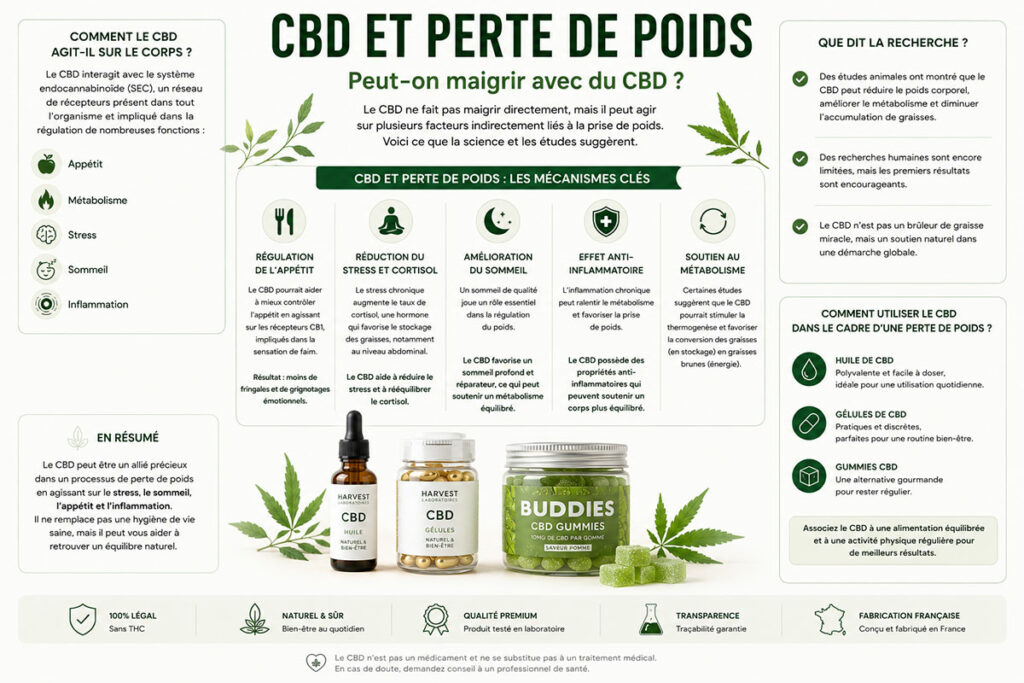
To understand where CBD could theoretically intervene, it is necessary to understand the endocannabinoid system (ECS). This is a network of receptors present throughout our body, which participates in the regulation of many functions: mood, pain, sleep, appetite, metabolism.
We are interested in two main receptors here:
- The CB1 receptor : very present in the brain and nervous system. Its activation is associated with an increase in appetite (this is what THC, which explains the "cravings" associated with cannabis).
- The CB2 receptor : mainly present in the periphery (immune system, intestines, adipose tissue). It plays a role in inflammation and energy metabolism.
CBD does not directly activate these receptors in the same way as THC. Rather, it acts as a negative allosteric modulator of CB1 and interacts indirectly with CB2. This more subtle mode of action explains why CBD does not have the "craving" effect of THC—and this is what has intrigued researchers about its potential metabolic role.
To delve deeper into the subject, we have a dedicated article on our blog: the dictionary of hemp, cannabis and CBD.
What scientific studies say about CBD and weight
Let's be honest from the outset: no large-scale clinical study currently demonstrates that CBD alone causes weight loss. What we do have are interesting leads, preliminary studies (often on animals or small human samples) that raise hypotheses.
Hypothesis 1: the conversion of white fat → brown fat
An in vitro study published in 2016 in Molecular and Cellular Biochemistry (Parray & Yun) suggested that CBD could promote the conversion of white fat cells (storage) into brown fat cells (energy burning). In theory, this process, called "browning," could improve energy expenditure. A major limitation : these results were obtained on cells in the laboratory, not in humans. They therefore remain a preliminary finding.
Hypothesis 2: Carbohydrate and lipid regulation
Several animal studies have observed that oral administration of CBD appeared to improve glucose tolerance and lipid metabolism in rodents fed a high-fat diet. However, this finding has not been directly extrapolated to humans by peer-reviewed clinical trials.
Hypothesis 3: The 2024 THCV + CBD study
The most significant study in recent years was published in 2024 by Dr. Smith in the journal Cannabis. It tested, over 90 days, in a double-blind, placebo-controlled trial, oral strips combining THCV (tetrahydrocannabivarin) and CBD in 44 obese adults (BMI ≥ 30). Results: statistically significant weight loss, reduced waist circumference, lower systolic blood pressure, and improved lipid profile (total and LDL cholesterol).
A crucial distinction : the active molecule in this study is primarily THCV, a cannabinoid distinct from CBD. CBD was present in a very small dose (10 to 20 mg) as a supplement. The key takeaway: the encouraging results mainly concern THCV, not isolated CBD. This distinction is rarely made clear in articles for the general public.
Hypothesis 4: Indirect action via stress and sleep
This is the most solid lead to date, and we will dedicate the following section to it.
Where CBD might play an indirect role: stress and sleep
While the direct effect of CBD on weight loss remains to be proven, there is, however, a more substantial body of literature on its potential effects on anxietyand sleep .And, as we saw earlier, chronic stress and lack of sleep are two major factors in weight gain.
Stress and CBD : Several studies (including a review published in Frontiers in Pharmacology in 2020) have reported anxiolytic effects of CBD at varying doses. The mechanism appears to involve, in particular, an interaction with 5-HT1A serotonin receptors.
Sleep and CBD : A clinical study published in The Permanente Journal in 2019 (Shannon et al.) observed improvements in anxiety scores and sleep quality in 72 adults after taking CBD. The sample size is small, and the protocols need refinement—but the signal is there.
In short: if CBD helps you better manage stress and improve sleep quality, it can indirectly support a lifestyle more conducive to weight loss. The mechanism isn't "CBD burns fat," it's "CBD improves two factors that influence your metabolism and eating habits."
To learn more about this topic, see our full report on CBD and sleep.
Important limitations to understand
To be honest, here are the limits of what can be said today about CBD and weight loss.
CBD alone does not cause weight loss
No solid clinical study demonstrates this. If someone promises you otherwise, be wary.
The effects vary enormously from person to person
Metabolism, route of administration (sublingual, oral, inhaled), dosage, product quality, genetics—all these factors influence the effects. Two people taking the same CBD can have very different experiences.
Animal studies cannot be automatically transferred to humans
This is a classic bias in “CBD and health” articles on the Internet: studies on mice are cited, implying that the results apply to you.
CBD is not a substitute for a balanced diet or physical activity
And no one in the scientific community has ever seriously claimed otherwise.
Some drug interactions exist
CBD is metabolized by the liver via the CYP450 enzyme, like many medications. If you are taking medication, talk to your doctor before taking CBD. See our article on CBD and medications.
How to integrate CBD into an overall healthy lifestyle?
If you want to integrate CBD into a comprehensive approach to well-being (and weight management), here are the pillars on which it makes sense to consider it — always as a complement, never as a substitute.
1. Improve stress management
Many users report a calming effect from CBD at moderate doses. It doesn't replace proper mental hygiene (sleep, social contact, meditation, therapy if needed), but it can be part of that routine.
2. Support better quality sleep
Where sleep is disrupted, taking CBD in the evening can potentially help with relaxation before bedtime. This is one of the most frequently reported uses by consumers.
3. Supporting athletic recovery
Physical activity is a central element of any weight management approach. CBD is being explored by some athletes for its potential effect on muscle recovery and managing soreness. Read more: Can you take CBD before a marathon?
4. Maintain a truly balanced diet
No supplement can replace a well-balanced diet. CBD doesn't change that equation.
5. Consult a professional
If you're aiming for a serious weight loss plan, talk to a nutritionist or dietitian. This is the starting point for a structured and personalized approach.
Which CBD products should be prioritized in this context?
If you decide to incorporate CBD into your lifestyle, here are the most relevant formats depending on the intended use.
For stress management and sleep
Sublingual CBD oils are the most scientifically studied method of administration. They offer good bioavailability, precise dosage, and a relatively rapid effect (30 to 60 minutes). A full-spectrum CBD oil is recommended to benefit from the entourage effect
For a simple daily routine
CBD capsules are the most convenient option: no taste, fixed dosage per capsule , perfect for regular use.
For the tasting and the ritual
Infusing CBD flowers ( never smoked for lung health reasons) offers a welcome moment of relaxation. Combine with a fat (milk, MCT oil ) to optimize cannabinoid absorption.
Important note on “CBD slimming supplements”
Many products make aggressive claims (“CBD for weight loss,” “CBD for appetite suppression,” etc.). These formulations often don't comply with regulations, and their composition isn't always clear. Choose products with a complete laboratory analysis and a seller who is transparent about the ingredients. This is our standard at CBD.fr—every product comes with its certificate of analysis.
FAQ
Does CBD help with weight loss?
To date, no robust clinical study has demonstrated that CBD alone causes weight loss. There are some promising leads (effect on brown fat, blood sugar regulation), but these remain preliminary. The best-documented effect is indirect, through stress management and improved sleep.
Does CBD suppress appetite?
Not really, contrary to what some articles claim. CBD has no documented appetite-suppressant effect in humans. The molecule that shows results in terms of satiety is THCV, a different cannabinoid.
How long before I see effects?
Regarding stress management and sleep, some users report effects from the very first doses. For a holistic approach to healthy living, think in terms of weeks or months—as with any lasting change.
Is CBD dangerous?
The WHO published a report in 2018 indicating that CBD is generally well-tolerated with a good safety profile. However, be aware of potential drug interactions (CYP450 pathway in the liver), especially if you are taking chronic medication. Consult your doctor.
What dose of CBD should I take?
There is no universal dose. Protocols vary from 10 mg to several hundred mg per day, depending on the studies and indications. The wise principle: start low, increase gradually, and observe how you feel.
Is CBD legal in France?
Yes, provided that the final product contains less than 0.3% THC (the European limit) and that the CBD comes from authorized varieties. All products sold on cbd.fr comply with these regulations.
In summary
Let's be clear: CBD is not a weight-loss product. However, it can be part of a holistic approach to healthy living, supporting two factors that indirectly influence weight: stress management and sleep quality. Any sustainable weight loss relies on the fundamentals—a balanced diet, regular physical activity, sufficient sleep, stress management, and medical guidance if needed. CBD can be one ingredient among others in this equation. It is not a solution on its own.
To explore our selection, click here: CBD oils, CBD capsules, and our entire range of CBD flowers with complete laboratory analyses.
Main scientific sources
- Smith GL (2024). Weight Loss and Therapeutic Metabolic Effects of Tetrahydrocannabivarin (THCV)-Infused Mucoadhesive Strips. Cannabis.
- Parray HA, Yun JW (2016). Cannabidiol promotes browning in 3T3-L1 adipocytes. Molecular and Cellular Biochemistry.
- Shannon S. et al. (2019). Cannabidiol in Anxiety and Sleep: A Large Case Series. The Permanent Journal.
- WHO/WHO Expert Committee on Drug Dependence (2018). Cannabidiol (CBD) Critical Review Report.
- Regulation (EC) No 1924/2006 of the European Parliament and of the Council on nutrition and health claims made on foods.
Disclaimer: This article is for informational purposes only. CBD is not a medicine and should not replace any medical treatment. Before undertaking any weight loss or lifestyle changes, consult a qualified healthcare professional.

Editor-in-Chief specializing in CBD
Julien, born on July 17, 1978, in the Paris region, is a prominent writer and expert in the field of CBD products. Following his studies, Julien developed a passion for natural remedies, including CBD. In 2022, he joined the CBD.fr team as an expert and regular contributor. Thanks to his scientific expertise and clear writing style, Julien helps demystify the complexities of CBD, while highlighting its benefits and potential applications through his articles and conference presentations.