
Properly storing your CBD flowers remains key to preserving their aroma, freshness, and wellness properties over the long term. In 2026, with the evolution of products, cultivation methods, and distribution channels, consumers expect shelf life without compromising the original quality of their cannabidiol. However, numerous common mistakes still jeopardize the preservation of legal cannabis, both for individuals and in specialized shops. This article focuses on the best home storage solutions, essential accessories, the dangers of improper storage, and some practical tips to help you get the most out of your stash.
Why does storage have such a significant impact on CBD flower?
Hemp naturally produces trichomes where cannabinoids and terpenes are concentrated, responsible for the desired taste and effects. Once harvested, dried, and cured, the buds remain susceptible to several environmental factors. Prolonged exposure to air or humidity accelerates their degradation, causing a loss of potency and aroma, and sometimes the appearance of harmful mold.
Any mismanagement of the storage environment can transform a good CBD flower into a bland, dry, or even unfit product. Therefore, preserving freshness is not just a minor detail; it's essential to maximizing the value of each purchase and avoiding waste.
Key factors to monitor to extend shelf life
Maintaining the quality of CBD requires a precise understanding of the parameters that make the difference. In addition to packaging,temperature ,humidity, and light each play a major role in protecting the finished product. To delve deeper into this topic, consult this guide on storing flowers and resins.
Temperature: why is precise control necessary?
Excessive heat accelerates the decomposition of valuable chemical compounds present in CBD flower. Conversely, temperatures that are too low risk causing condensation inside the airtight container when moved from room to room, promoting mold growth.
Storing your flowers between 15 and 21°C is an ideal range to minimize risks while preserving their suppleness and active compounds. Some climate-controlled cabinets specifically designed for herbalism are already appearing on the consumer market to ensure this temperature control, but cool areas outside of a refrigerator are often sufficient at home.
Humidity: how to protect your flowers from excess?
Without protection from humidity, even an excellent CBD bud loses its texture and character. A moisture content above 65% increases the likelihood of fungal and bacterial growth, while below 55%, the flowers become brittle and lose flavor and potency.
Adding small desiccant packets (silica gel or other absorbent materials) helps regulate humidity, especially in airtight containers. There are also humidity control packs specifically designed for aromatic or medicinal plants, maintaining an optimal balance of around 58-62% relative humidity.
Recommended containers for effective storage
Refusing open plastic packaging and opting for sealed storage makes all the difference. Several options stand out depending on the intended duration, the volume stored, and the desired ease of access for regular consumption; in particular, our CBD flowers benefit from specially designed packaging.
Classic glass jar or tinted glass: which to choose?
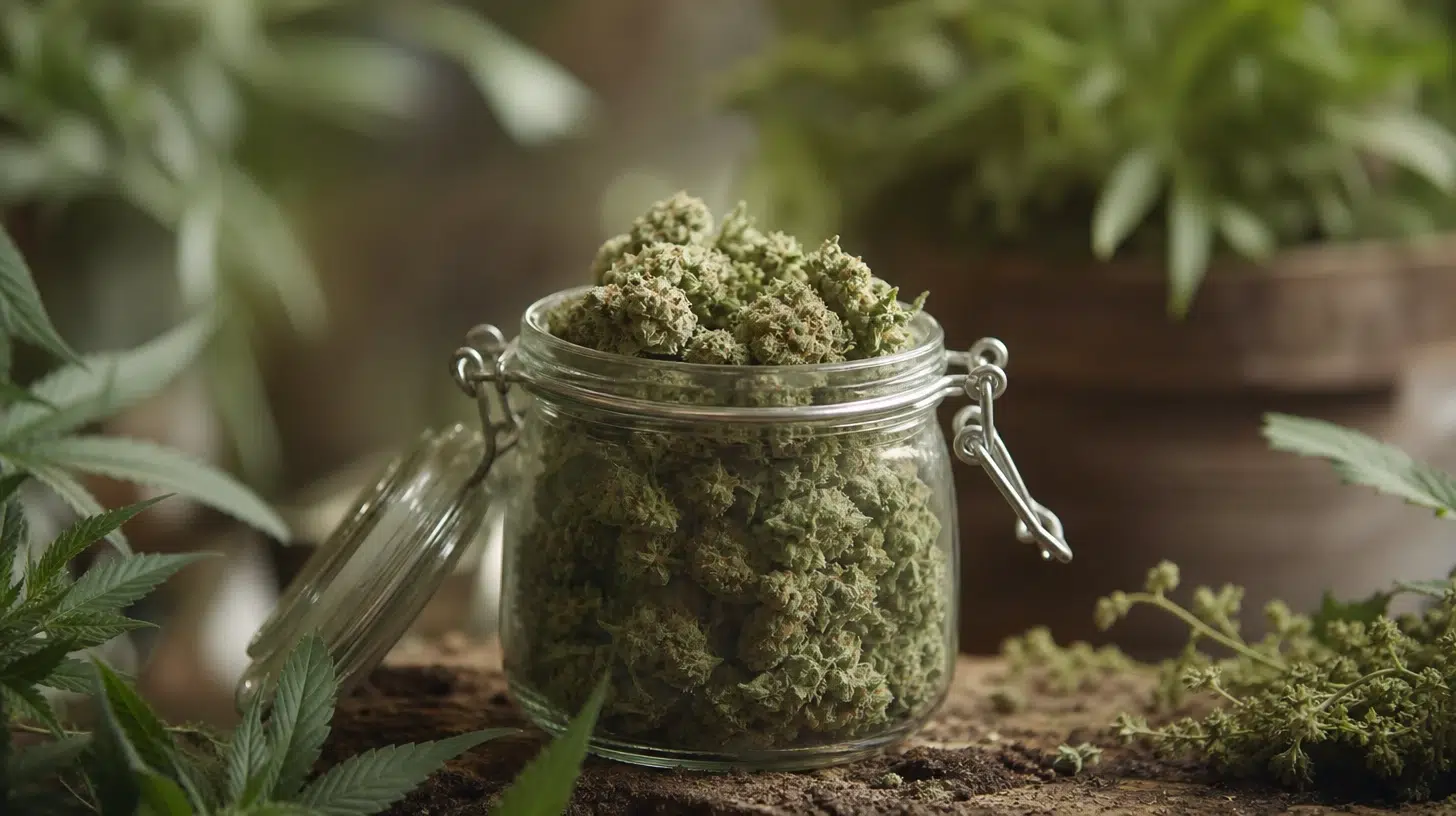
Using a glass jar remains the best option for daily or weekly use. Opt for a twist-off lid with a tight-fitting seal to create a perfectly airtight against ambient air, insects, and pollution.
For increased light protection, it is best to choose a jar made of tinted/dark glass : amber, green, or blue tint. This option blocks up to 90% of UV rays and guarantees darkness once the jar is stored safely on a shelf or in a cupboard.
Metal box, vacuum bag and other modern alternatives
The metal container offers an additional barrier against light and preserves aroma if the lid seals tightly .This option is appealing due to its unbreakable nature and portability, especially for storing small quantities that need to be transported.
Vacuum bags are gaining popularity in 2026. Using a manual or automatic pump, you remove the air, drastically reducing oxidation and microorganisms. This method is suitable for large volumes or bulk purchases, but frequent opening quickly reduces the system's effectiveness. It is therefore better suited for long-term storage or for setting aside a portion of stock not intended for immediate use.
- Glass jar with a sealed or silicone lid
- Tinted glass jar/dark glass
- High-end food-grade metal container
- Vacuum bag for extended storage
- Kraft paper bag (temporary use only)
- Treated wooden box (for discerning enthusiasts of gentle aging)
Where to store your containers? The importance of darkness and a dry place
Storing jars or containers directly in the kitchen exposes them to temperature fluctuations and sometimes high humidity. To ensure they last longer, it's best to choose a dark space with a stable temperature, away from appliances.
A closed cupboard, a ventilated cellar, or an ordinary drawer away from heat sources are ideal storage locations. Some enthusiasts invest in small thermo-hygrometer cabinets or specialized crates equipped with electronic sensors, eliminating the need for manual monitoring.
Shelf life: how long to keep your CBD flowers
Since the question "how long can you store CBD flower?" comes up frequently, a nuanced answer is necessary. Under good conditions, with an airtight container and careful attention to light and humidity,it's not uncommon to achieve six to twelve months of storage without any significant loss of quality.
The organoleptic profile—odor, texture, color—is the primary indicator of good preservation. As soon as these parameters visibly deteriorate (change in odor, excessive crumbling), the flower begins to lose its therapeutic and aromatic value, even if it remains edible. Reducing repeated exposure to ambient air and avoiding opening glass jars too frequently will further extend the effective shelf life
| Storage method | Indicative duration (months) | Benefits | Disadvantages |
|---|---|---|---|
| Tinted glass jar | 6 to 12 | UV protection, easy to open | Fragile during transport |
| Metal box | 4 to 8 | Compact, lightweight | Less airtight with a basic closure |
| Vacuum bag | 8 to 14 | Long-term storage, adjustable volume | Not ideal after opening |
| Kraft paper bag | 1 to 2 | Economical, sweats | Limited protection against air/light |
Mistakes to avoid when storing CBD flower
Some common mistakes affect both beginners and experts. Leaving flowers in a resealable plastic bag provided by the seller becomes problematic after just a few days: oxygen permeability and condensation accelerate drying. Storing them near a window or a heat source quickly alters the desired characteristics.
Another common mistake is stacking different batches without identification or dates. Without any markers, it's difficult to implement a rotation system ("first in, first out"). Mixing several varieties in the same container also negatively impacts their respective profiles: unexpected aroma blends, homogenization of smells, and possible moisture transfer from one bud to another.
- Forgetting to regularly check the condition of the flowers (presence of white spots, new smells…)
- Underestimating the power of indirect light and temperature variations
- Use unwashed containers, full of dust or old food flavorings
- Neglecting the periodic replacement of moisture-absorbing sachets
Common questions about CBD flower storage in 2026
What is the best method for storing CBD flower?
- Tinted glass to filter the light
- Silica gel sachets or special packs to control humidity
- Maintaining a stable temperature range (15-21 °C)
Should you store your CBD flower in the freezer or the refrigerator?
How can you tell if a CBD flower is still good?
- abnormal crumbly or sticky texture
- Evolution or disappearance of natural perfume
- Visible change in the color of the flowers
Can a simple plastic bag be used to store CBD flower?

Co-founder of CBD.fr
Julien Cordobes is the editor of CBD.fr. Born in 1978 in the Paris region, he first trained in e-commerce before turning to natural health approaches, a dual perspective that now structures his way of writing about cannabidiol: reading the scientific literature as it is, without hardening the conclusions, and presenting it in a language that everyone understands.
He discovered CBD at a time when the French market was developing faster than the information available to it. He acquired CBD.fr in 2022 and then took on editorial responsibility for the blog. Since then, he has published numerous articles covering the daily use of CBD, the interpretation of laboratory analyses, the evolution of the legal framework, and precautions for use.