
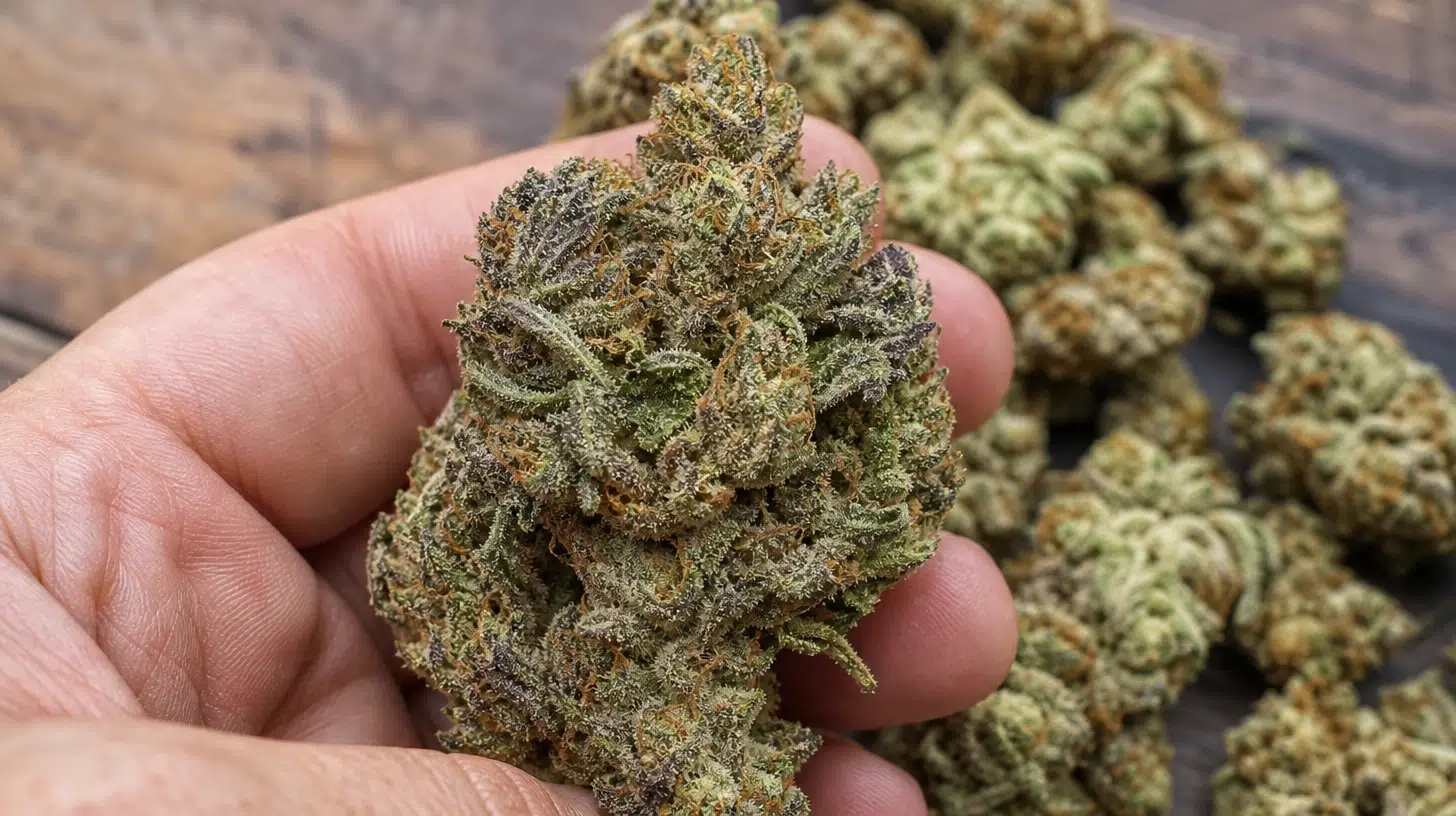

For a long time, cannabis enthusiasts attributed its entire aromatic range solely to terpenes. Yet, behind the legendary scents of gas, skunk , or tropical fruitslies a far more complex mosaic of chemical compounds. Beyond the classics like myrcene and limonene, other molecules contribute to these powerful and instantly recognizable olfactory signatures. Some, undetectable in the laboratory in their raw state, can radically transform the sensory experience even in minute quantities. Exploring the true origin of cannabis aromasmeans delving into the heart of a fascinating chemistry that blends science, nature, and botanical expertise.
Where do the iconic smells of cannabis come from?
The aromatic nuances so characteristic of cannabis result from a unique symbiosis of molecular families. While terpenes often dominate the conversation, they are only one piece of a much larger puzzle. Typical gassy aromas , punchy skunky accents , and exotic fruity notes arise from the subtle interaction between different chemical compounds, sometimes present in microscopic quantities.
The environment, the plant's genetics, and even cultivation and drying methods all influence the expression of certain olfactory profiles. Experienced growers know that two varieties with similar terpene profiles can nevertheless smell radically different when other families of molecules come into play. To deepen your understanding of these compounds, it's helpful to consult a guide on terpenes and their role in the plant. This is the art of going beyond terpenes to explore the sensory diversity of cannabis.
Exploration of the molecular families involved in intense odors
To understand why some flowers smell of gasoline, others of aged cheese or ripe mango, we need to focus on a few very particular classes of compounds. They define three major spectacular olfactory universes: sulfurous (gas/skunk), fermented, and tropical.
What compounds give the smell of gas and gasoline?
Gassy aromas are reminiscent of the smell of diesel, gasoline, or kerosene. This odor family rarely results solely from terpenes , but also involves lesser-known families such as thiols (or mercaptans). These sulfur-containing molecules, detectable in trace amounts, are capable of permeating a room even if their concentration is close to one millionth of a gram per kilogram of dry matter.
In particular, certain thiols already known in wine or seafood are now appearing in cannabis. Their aromatic power far surpasses that of terpenes . The addition of just a few nanograms of a thiol can make a strain instantly recognizable by its fuel-like, even ferrous, character. Other minor sulfur compounds also contribute to the diesel patina: thioesters, sulfoxides, and even certain oxidized naphthalenes are associated with it in some rare genetics.
What creates the skunk, fetid, or animalistic effect?
Skunk aromas get their name from North American skunks, which are known to produce a persistent odor when threatened. In cannabis, this skunky effect results from a synergy between thiols , volatile sulfur and sometimes nitrogen compounds. A prime example is 3-methyl-2-butene-1-thiol, infamous in flat beer, which directly contributes to the skunky smell of "skunky" cannabis.
Sometimes, fermented, cheesy, or even slightly ammoniacal notes appear when other small molecules called amines or volatile fatty acids come into play, amplified by the post-harvest maturation process. This combination makes the "old school" or cheese profiles so distinctive. Varieties known for their skunky aromas often exhibit a gassy bouquet enriched by these animal or astringent signatures.
Where do the scents of tropical and exotic fruits come from?
Some cannabis cultivars seem to have literally sprung from a fruit basket: mango, pineapple, passion fruit, or papaya. While myrcene and limonene obviously play a role in these scents, other families of molecules take over in modern varieties. Esters (ethyl butanoate, isoamyl acetate) form the basis of many of thefruity aromas perceived in modern cannabis and in many naturally occurring fruits; they impart sweetness, roundness, and aromatic vibrancy.
Other non-terpene compounds from the lactone (gamma-undecalactone for peach, delta-decalactone for apricot or coconut) intensify the impression of an exotic or creamy fragrance. The secret often lies in the combination of small quantities of several families: terpenoids, esters, aldehydes, and higher alcohols, which give rise to the renowned aromatic richness of tropical resins.
Impact of concentration and molecular synergy
A fascinating characteristic of the world of cannabis scents lies in the olfactory power of certain molecules, as well as their combination. Here, the fundamental principle of "top," "middle," and "base notes" applied in perfumery takes on its full meaning.
With thiols, human perception reaches extraordinarily low thresholds: a minute quantity is enough to profoundly transform a once discreet flower into an aromatic whirlwind. Conversely, certain terpenes must be present in several milligrams to make their mark. This phenomenon amplifies the overall complexity produced by the synergy between the different families of chemical compounds.
- Gassy aromas depend on ultra-powerful thiols and sulfur compounds (e.g., methanethiol).
- Skunk aromas result primarily from specific thiols , enhanced by amines and volatile acids.
- Exotic fruity aromas emerge from the coexistence of esters , certain lactones, and large terpene families .
- Earthy and woody notes are derived mainly from terpenes (humulene, pinene, caryophyllene) but are nuanced by small auxiliary molecules.
- Floral notes reflect the balance between linalool, geraniol and some minor esters.
This principle of the cocktail effect is central: an isolated molecule may seem harmless until it encounters its "partners" in the mature plant. Sometimes, modifying the composition by microdoses radically alters the final signature, explaining the major differences between phenotypes that are otherwise similar from a purely terpene perspective.
Comparative table of compounds responsible for the main aromas
Summary of key compounds involved in the distinctive signatures of cannabis:
| Olfactory profile | Molecular families | Examples of compounds |
|---|---|---|
| Gas / Petrol | Thiols, thioesters, hydrocarbons | Methanethiol, ethanethiol, dimethyl sulfide |
| Skunk / Fetid | Thiols, amines, volatile acids | 3-Methyl-2-butene-1-thiol, triethylamine, butyric acid |
| Exotic fruits | Esters, lactones, terpenes | Ethylbutanoate, gamma-undecalactone, myrcene |
| Earthy / Woody | Terpenes, ketones, pyrazines | Humulene, pinene, geosmin |
| Floral | Esters, terpenes, alcohols | Linalool, geraniol, benzyl acetate |
This chart illustrates that cannabis aromas result from complex cocktails of compounds, some of which do not belong to the terpene. Each contributes its own nuance, allowing for an infinite number of aroma profiles, from fresh and woody notes to very pronounced tropical or sulfurous bursts.
The importance of maturation, drying and preservation
The development of cannabis aromas goes far beyond genetics alone. The stage of maturity at harvest, followed by the art of drying and curing, determines the retention or emergence of volatile molecules . Certain families (thiols, esters) are sensitive to excessive humidity or oxidation, quickly disappearing if the plant is mishandled.
Controlled ventilation and maintaining precise humidity levels during curing, conversely, enhance the desired flavor profiles. However, improper handling can promote the formation ofsecondary aromas , such as excessive fermentation, mold, or abnormal production of volatile amines. Mastering post-harvest processes is therefore just as crucial as selecting good genetics to obtain balanced and memorable flavor profiles.
Why do some strains smell strongly of gas when they seem to be low in classic terpenes?
The aromas of gas don't primarily depend on abundant terpenes, but rather on the presence of sulfur-containing molecules like thiols. These highly potent compounds are active at minute concentrations, which explains their disproportionate olfactory impact. Even in small quantities, they are enough to create a very pronounced gassy aromatic signature, imperceptible through conventional terpene analysis.
- Thiols and thioesters have the lowest detection threshold among cannabis compounds.
- Their combination with certain terpenes produces a unique synergistic effect.
How can we explain the appearance of exotic fruit aromas in modern genetics?
Tropical aromas come from a blend of specific terpenes, aromatic esters, and sometimes lactones, reminiscent of mango or pineapple. Recent hybridization has highlighted certain genes carrying these molecular syntheses, resulting in extremely fruity and sweet profiles.
- Myrcene and limonene provide a fruity base
- Esters (ethyl butanoate) and lactones add round and sweet notes
- Varietal selection reinforces these rare combinations
| Molecule | Aroma |
|---|---|
| Gamma-undecalactone | Peach, apricot |
| Isoamyl acetate | Bananas, candy |
Do drying techniques really influence the aromas of cannabis?
Drying and storage play a fundamental role in preserving or destroying aromatic compounds. Slow drying at a controlled temperature protects the families of volatile molecules responsible for the finest aromas, while exposure to heat or humidity promotes the loss of esters, the degradation of terpenes, and the appearance of undesirable secondary aromas.
- A suitable curing process enhances the fruity, floral, and skunk notes
- Excess humidity promotes the formation of volatile acids and amines
Can sulfur molecules (thiols) be distinguished from terpenes by smell?
Experts often recognize the ultra-powerful signatures of thiols by their gaseous, fuel-like, or oniony aromas, clearly distinct from the herbaceous or citrusy scents of traditional terpenes. However, the line remains subtle, and training the nose helps to better distinguish these olfactory families, especially when they are present in minimal but decisive amounts.
- The sulfurous notes evoke raw egg, rubber, and gasoline
- The terpene notes are reminiscent of citrus fruits, pine, and lavender

Co-founder of CBD.fr
Julien Cordobes is the editor of CBD.fr. Born in 1978 in the Paris region, he first trained in e-commerce before turning to natural health approaches, a dual perspective that now structures his way of writing about cannabidiol: reading the scientific literature as it is, without hardening the conclusions, and presenting it in a language that everyone understands.
He discovered CBD at a time when the French market was developing faster than the information available to it. He acquired CBD.fr in 2022 and then took on editorial responsibility for the blog. Since then, he has published numerous articles covering the daily use of CBD, the interpretation of laboratory analyses, the evolution of the legal framework, and precautions for use.



How to decipher aromatic profiles during tasting?
Distinguishing the aromas of cannabis requires a trained nose, capable of seeing beyond the dominant layer of terpenes. Detecting the sudden appearance of a gassy, the emergence of a cheesy accent, or the caress of a tropical fruit requires a broad vocabulary and sensory experience.
In a tasting workshop, using olfactory references from other worlds—natural wines, aged cheeses, fresh tropical fruits, natural essences—can, through association, help identify and classify the unique facets of a sample. Cultivating this "nose" culture refines the understanding of the incredible range ofaromas offered by contemporary cannabis botany.