

In the vast world of cannabis , certain strains emerge as timeless classics, capable of transcending decades without losing their appeal. Orange Bud is undoubtedly one of these must-haves. This cannabis strain , renowned for both its fruity aromas and its impressive legend, continues to enchant CBD enthusiasts seeking authenticity. Through this exploration, discover the history of Orange Bud , from its Californian roots to its place in the legal cannabis market .
The origins of Orange Bud: a visionary cross
Tracing thehistory of Orange Budis like diving into the vibrant cannabis scene of the 1980s. At a time when California was witnessing the emergence of innovative strains, the firstOrange Bud came from a skillful cross of different Skunk. This blend quickly proved promising, giving rise to a cannabis variety whose modernity is still felt today in the world of CBD.
Legend has it that Orange Bud originated from a cross between several Skunk phenotypes selected for their organoleptic qualities and dynamic effects. Pioneering growers sought a pronounced sativa dominance combined with distinctive aromas . Once the selection was stabilized, Orange Bud was introduced to the Netherlands , which accelerated its international popularity, particularly thanks to the opening of coffeeshops and the growing legalization of cannabis .
From the United States to the Netherlands: the spread and establishment of a cannabis icon
The United States is central to the identity of this CBD variety . From the late 1970s and especially during the 1980s , American breeders experimented with genetics from Asia, Central America, and the Middle East. California played a fundamental role, with a community of enthusiasts determined to create the most flavorful and resilient cannabis possible
Faced with increasing repression, many growers migrated to Europe, with the Netherlands becoming a veritable laboratory for cannabis innovation. It was there thatOrange Bud truly took off and established its reputation among connoisseurs. This transition paved the way for the emergence of a structured industry centered around feminized seeds, making the variety accessible internationally.
The impact of the 1980s on international reputation
During this pivotal decade, Orange Bud distinguished itself not only for its flavor but also for its ability to deliver a consistent and reliable experience. The progressive climate of the Netherlands facilitated its rapid adoption. Orange Bud 's solid reputation is thus built on its consistent performance and resilience in both indoor and outdoor cultivation.
Over time, this genetic diversity has made it possible to preserve the very essence of the variety while facilitating adaptation to different markets, up to the development of the modern CBD.
A bridge between Californian tradition and European innovation
Orange bud has a dual heritage: it carries within it the nonconformist spirit of Californian pioneers, but it also embodies Dutch rigor and ingenuity . This balance explains why it remains so sought after among CBD derivative products , now offered legally .
Finally, the rapid circulation of the original seeds between the two continents supported the diversity of regional adaptations, allowing the variety to transcend fashions without ever falling into oblivion.
Unique aromas and botanical characteristics
The distinctive identity of Orange Bud lies first and foremost in its fruity aromas . Its olfactory profile unmistakably evokes the zest of freshly squeezed oranges , a touch of lemon accompanied by a sweet floral note. These scents are reminiscent of both Californian citrus groves and the colorful displays of Dutch coffee shops.
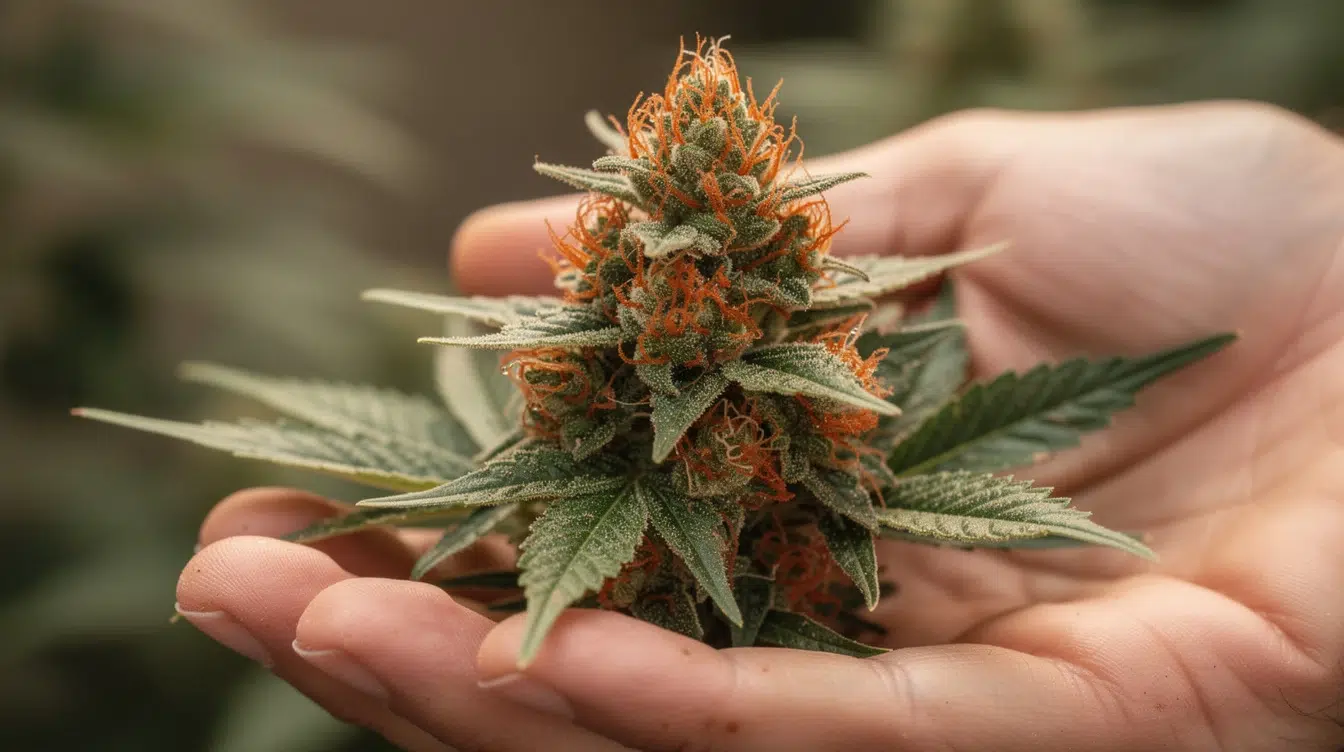
Beneath the surface, theorange bud displays a robust structure typical of predominantly sativa, characterized by long, orange pistils, hence its name. The compact flowers, covered in abundant trichomes, are reminiscent of White Rhino CBD, another variety prized for its visual appeal and potent aromas.
Sativa dominance: dynamism and versatility
It's no coincidence that Orange Bud is often described as a "vibrant" strain . Its sativa dominance gives it a stimulating effect, particularly appreciated in the context of CBD . It stands out as a relevant choice for those seeking mental clarity or creativity without feeling weighed down.
Its natural properties differ markedly from other members of the Skunk, which are more indica-dominant. This unique characteristic largely contributes to its longevity on the market.
Skunk and Orange Bud: close cousins but distinct identities
Historically, Orange Bud belongs to the large Skunk family , famous for its powerful aromas and generous yields. Yet, it manages to assert its own personality with its citrus bouquet and a sensory experience that sets it apart from classic Skunk
These differences explain whyorange bud remains a favorite, serving today as a reference both among collectors and in modern ranges of CBD dedicated to well-being.
Orange bud and CBD: the evolution towards legal cannabis
Since the 2010s, the regulatory framework has been evolving in Europe and elsewhere, opening the door to a new wave of legal cannabis focused on CBD. OrangeBud naturally benefits from this enthusiasm, as its solid reputation both reassures and intrigues curious consumers.
Now, the CBD version of this strain represents an ideal compromise between authentic flavor and compliance with regulations. No other hybrid combines history , sativa dominance , and an exceptional aromatic profile with such elegance
Distinguishing Orange Bud CBD from its THC-rich ancestors
While the genetic heritage is real, the major difference now lies in the THC . Plants producing purified cannabidiol undergo strict processes to ensure compliance with European regulations.
To obtain a final product faithful to the original experience, breeders cultivate plants naturally low in THC while preserving the aroma and dense structure that make OrangeBud.
Popular CBD variety: why does this success persist?
Its ability to combine fruity aromas , a subtle effect, and a prestigious history fosters consumer loyalty. On the shelves of specialty shops,Orange Bud CBD attracts customers with its promise of authenticity and smoothness, without breaking any laws.
This phenomenon can be observed both among novices eager to discover wellness cannabis and among connoisseurs anxious to rediscover the original spirit of the 1980s without marked psychoactivity.
Recognizing, appreciating, and choosing an authentic orange bud
To fully enjoy this experience, a few criteria help distinguish CBD orange bud . Beyond the potent aroma reminiscent of ripe citrus, certain visual and sensory characteristics guide connoisseurs' choices.
Compact flowers, bright orange pistils, and abundant trichomes remain the main markers. A sensory analysis also reveals a subtle complexity, oscillating between sweetness and fruity acidity, the unique signature of the true orange bud.
- Strong scent of fresh orange and lemon
- Colourful pistils and dense appearance
- A light, dynamic sensation, without bodily heaviness
- High natural CBD content for the legal segment
The care taken in cultivation directly influences the final quality. Choosing producers who are transparent about their origin guarantees an experience true to the tradition of this legendary cannabis strain
What are the true aromas of orange bud?
- Strong citrus flavors (orange, lemon)
- Slight floral presence
- Typical skunk grassy base
How to differentiate between an orange bud cbd and a classic skunk?
- Orange pistils versus yellow/brown pistils
- Fruity profile vs. earthy/acidic scent
- Low THC content
What part of the history of Orange Bud remains associated with the 1980s?
| Decade | Major event |
|---|---|
| 1980 | Birth and first international broadcast |
| 1990 | Popularization in Europe via coffeeshops |
| 2000+ | Development of the legal CBD/cannabis segment |
Why choose Orange Bud CBD from among all the legal varieties available?
- Authenticity (respect for traditions)
- Unparalleled citrus scents
- High concentration of regulated CBD

Co-founder of CBD.fr
Julien Cordobes is the editor of CBD.fr. Born in 1978 in the Paris region, he first trained in e-commerce before turning to natural health approaches, a dual perspective that now structures his way of writing about cannabidiol: reading the scientific literature as it is, without hardening the conclusions, and presenting it in a language that everyone understands.
He discovered CBD at a time when the French market was developing faster than the information available to it. He acquired CBD.fr in 2022 and then took on editorial responsibility for the blog. Since then, he has published numerous articles covering the daily use of CBD, the interpretation of laboratory analyses, the evolution of the legal framework, and precautions for use.


