
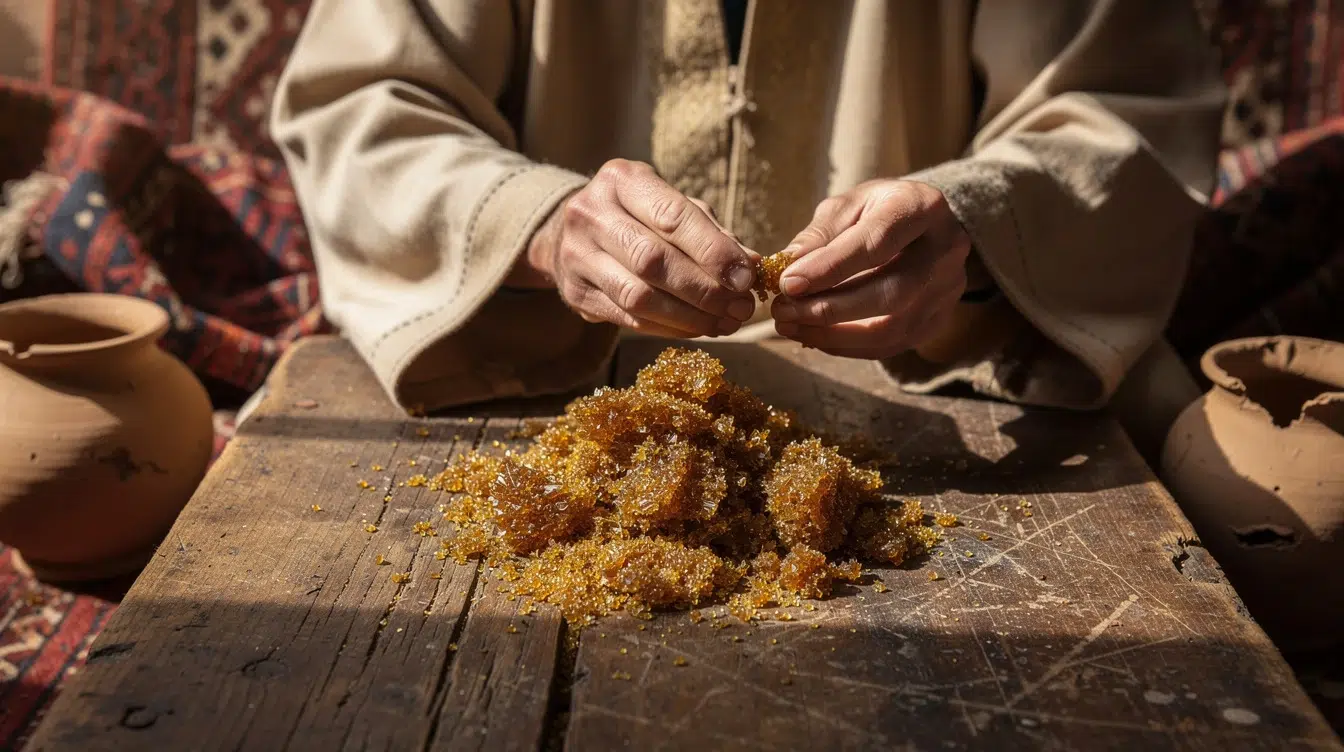

To talk about Ketama Goldis to recount one of the most fascinating chapters in the contemporary history of cannabis. This CBD resin, prized for its smoothness and woody aromas, carries within it the legacy of a long Moroccan tradition. Behind its golden appearance and compact texture, Ketama Gold is much more than just a product enjoyed by legal CBD : it embodies the evolution of artisanal know-how and the adaptation to new trends sweeping the cannabis world, all while maintaining its deep roots in the Rif region.
The ancestral origins of cannabis resin in the Rif region
The Rif region in northern Morocco has been synonymous with hashish production for centuries. It was there, at the foot of the mountains, that the first artisanal methods of hashish production developed , inspired by skills passed down through generations. The Berber people, masters of hemp pressing , have shaped a unique culture around this plant, a symbol of the connection between the land and humankind.
Long before the rise of the global cannabis, Moroccan tradition already favored hardy and resilient varieties. These plants, often adapted to the harsh mountain climate, gave rise to a legendary hashish, characterized by earthy notes and a rich aromatic profile, quite different from resins from other Mediterranean regions. Among modern CBD resins, Le Jaune perfectly illustrates this evolution of Moroccan expertise. This living heritage paved the way for the future emergence of CBD resins such as Ketama Gold.
From traditional Moroccan cannabis to the CBD revolution
From the late 20th century onward, the global perception of cannabis underwent a profound transformation. In search of new uses and potential benefits, the international community focused on cannabidiol (CBD), a non-psychoactive molecule naturally present in hemp. This shift paved the way for a major evolution in production methods in the Rif region, without severing ties to Moroccan tradition.
Thus, to meet the growing consumer demand for high concentrations of CBD and sometimes CBG, some Rifian growers have selected new varieties of industrial hemp. To discover other exceptional products, also see our selection of the best CBD flower varieties. The result: a modern, refined CBD resin, true to its origins, capable of appealing to both lovers of authentic flavors and those who embrace contemporary wellness.
Why has the Rif region remained the beating heart of CBD resin production?
It's difficult to separate Ketama Gold from its native land. Just a few years after the advent of high- CBD, the villages of the Rif region continue to perpetuate unchanged agricultural practices: manual harvesting, sifting, and gentle pressing of hemp. This close connection to the raw material guarantees unique organoleptic characteristics and unparalleled quality in European and global markets.
But the Rif region's reputation also stems from its capacity for respectful innovation. Growers there now combine old local seeds with hybrid varieties designed to promote high CBD concentrations , in order to obtain a resin whose purity and potency meet current expectations.
A handcrafted know-how passed down and adapted
The legend of Ketama Gold was written, and continues to be written, thanks to a complex expertise: combining traditional techniques of dry sieving, hot or cold pressing, and new curing methods that highlight the richness of the cannabinoids. The mastery of the compact, malleable, or even powdery texture, depending on the batch, testifies to an expertise acquired over time.
Far removed from standardized industrial production, each batch offers specific nuances, dictated by the fineness of the grain and the care taken in the manual process. This rediscovered humanity in the product explains why hash from the Rif region remains so unique compared to other CBD resins.
Under the seal of ketama gold: sensory profile, method and authenticity
Ketama Gold is not only a tribute to the Moroccan cannabis tradition, but also an invitation to a sensory journey. Easily recognizable by its golden to amber color, it reveals a supple texture making it easy to crumble. Each step, from harvesting to curing, leaves its mark on the final quality of the product.
This hash derives its strength from a subtle balance between cannabinoid concentration, smoothness, and a particularly pronounced aromatic bouquet: earthy and woody notes, enveloped in more discreet aromas reminiscent of fresh bark or forest moss. This rarely equaled olfactory signature appeals to connoisseurs and attracts those seeking a natural experience in their CBD resin.
Manufacturing methods: which steps determine quality?
Creating hash worthy of the Ketama Gold name requires precision and patience. The hemp are first harvested and then meticulously dried. Next comes the "beating": rubbing the dried buds against a sieve collects the kief, a fine golden powder saturated with trichomes, the raw material for all the great resins of Morocco.
The kief is then pressed by hand, often at a moderate temperature to avoid altering the cannabinoids and to preserve the flavor. Some producers choose to age the kief in cellars, giving the final product a more compact texture and greater aromatic complexity. This process, combined with in-depth knowledge of the plants and the local climate, shapes the exceptional quality of Ketama Gold.
Ketama Gold in the global landscape of legal CBD
The arrival of legal CBD has revolutionized the relationship between traditional producers and new players in the sector. While most European countries allow the sale of resin with a low THC (less than 0.3%), they also value origin and respect for traditional craftsmanship. In this context, Ketama Gold occupies a unique position, becoming emblematic of the convergence of Moroccan authenticity and contemporary standards.
Discerning consumers are no longer satisfied with just a high CBD concentration. They seek products that carry a story, a geographical connection, capable of offering them something more. The renown of Ketama Gold therefore rests as much on the quality of the resin as on the cultural identity associated with the Rif region and the Moroccan tradition of cannabis.
What are the differences compared to other European resins?
Faced with the growing supply from Switzerland, Italy, and even Spain, Ketama Gold maintains a significant advantage. First, its artisanal contrast sharply with the trend toward mass mechanical extraction. Second, its powdery texture , which crumbles easily and then becomes silky to the touch, clearly distinguishes it from the oilier or plastic-like hash offered elsewhere.
The use of robust genetics, selected for their adaptability to the mountain climate, contributes to the intensity of its flavors and a stable CBD content. Finally, Moroccan growers maintain a rare symbiosis between humans and the land, absent from many modern industrial farms. This loyalty to the source remains a major added value for enthusiasts of traditional CBD resin.
Prospects and challenges for Moroccan hash in the CBD era
While Ketama Gold is thriving on the international market, it faces a series of changes. The gradual integration of legal CBD is putting pressure on small producers: they need to train in regulations, constantly adapt cultivated varieties, and maintain consistent quality despite increased demand. These challenges are compounded by the environmental issues related to natural resource management in the Rif region.
Nevertheless, this transitional phase opens the door to a renewed recognition of Moroccan tradition. The promotion of handcrafted resin, produced using sustainable and transparent practices, reinforces the position of ketama gold as the standard-bearer of a know-how firmly rooted in modernity without betraying its origins.
- Texture : compact, malleable or powdery, reflecting the pressing method and the degree of refining.
- Colour : from golden blonde to amber, the visual signature of pure kief.
- Main aromas : woody, earthy notes, punctuated with herbaceous or spicy touches.
- Cannabinoid content : CBD concentration generally higher than average, variable presence of CBG.
- Manufacturing technique : adherence to dry sieving, artisanal pressing, slow maturation.
What is the difference between Ketama Gold and other European CBD resins?
- Manufacturing method: Ketama gold is made using a traditional Moroccan artisanal technique, while many European resins are produced industrially.
- Organoleptic profile: it has woody/specific aromas and a unique, more malleable and powdery texture.
- Concentration: genetic selection and the climate of the Rif favor high levels of CBD and sometimes CBG.
| Resin type | Origin | Main aromas | Texture | Average CBD (%) |
|---|---|---|---|---|
| Ketama gold | Rif region, Morocco | Wooded, earthy | Powdery/malleable | 15-25 |
| Swiss premium | Swiss | Floral, fruity | Dry or sticky | 10-16 |
What are the organoleptic characteristics of Ketama Gold?
- Main notes: woody, earthy aromas, with a hint of spice and herbaceousness, inherited from the Moroccan terroir.
- Visual appearance: light and golden tint, indicating precise sifting of the kief.
- Texture in use: the hash crumbles easily and becomes malleable under the fingers.
Why are we talking about high concentrations of CBD and CBG?
The hemp varieties used in the Rif region have been adapted to produce high levels of CBD, the main molecule sought after for its legal and wellness benefits. CBG is sometimes added to this blend: a lesser-known substance prized for its complementary properties.
- Adapted genetics, specifically cultivated to boost cannabinoid content.
- The climate and soil of the Rif region are conducive to the optimal development of flowers rich in active ingredients.
- A manufacturing process that preserves the purity and potency of the kief obtained during sieving.
Can the cultivation of CBD hash in the Rif region evolve with European demand?
Current trends demonstrate a genuine capacity for adaptation: the introduction of new varieties, improved agricultural techniques, and training in legal export. However, the main challenge remains maintaining Moroccan tradition and preserving the Rif ecosystem.
- Gradual evolution of practices in the Ketama area, the cradle of Moroccan CBD hash.
- Increasing emphasis on traceability and natural processes to reassure the European consumer.

Co-founder of CBD.fr
Julien Cordobes is the editor of CBD.fr. Born in 1978 in the Paris region, he first trained in e-commerce before turning to natural health approaches, a dual perspective that now structures his way of writing about cannabidiol: reading the scientific literature as it is, without hardening the conclusions, and presenting it in a language that everyone understands.
He discovered CBD at a time when the French market was developing faster than the information available to it. He acquired CBD.fr in 2022 and then took on editorial responsibility for the blog. Since then, he has published numerous articles covering the daily use of CBD, the interpretation of laboratory analyses, the evolution of the legal framework, and precautions for use.




How can you recognize genuine Ketama Gold resin?
Several clues help identify authentic ketama gold. Its color, ranging from light blonde to golden amber, differs noticeably from most classic hashish, which is often darker. A light squeeze between the fingers quickly reveals a malleable texture, neither too dry nor too oily, indicating perfectly controlled pressing.
Another distinctive aspect is the high concentration of CBD, frequently accompanied by a significant level of CBG, the result of careful selection of cultivated varieties. On the palate and nose, the aromatic bouquet is unmistakable, the resin immediately revealing woody, spicy, and slightly sweet aromas characteristic of Moroccan tradition.