


Terpenes are aromatic compounds found in many plants, notably hemp, where they are produced in the trichomes . Several terpenes exist, but for this article, we'll focus on just one: limonene . Let's explore this in detail below.
Presentation and name
In fact, before delving into technical considerations, it would be advisable to begin with a simple identification of limonene. With this in mind, we suggest focusing on its definition and the explanation of its name.
Put that way, how can we define it? This article presents it as follows:
Limonene (C10H16 ) is a terpene hydrocarbon found in many essential oils , from which it can be obtained by distillation. At room temperature, it is a colorless liquid with a bright, fresh, clean orange scent, characteristic of citrus fruits. Limonene is notably used in perfumery.
Source: https://fr.wikipedia.org/wiki/Limon%C3%A8ne
The same source added that he:
(…) is a chiral molecule, and, as with many chiral molecules, biological sources produce a specific enantiomer. The main industrial source, the orange, contains D-limonene ((+)-limonene), which is the R . Eucalyptus and peppermint, on the other hand, contain L (–)-limonene, which is the levorotatory S enantiomer. Racemic limonene is known as dipentene.
Source: https://fr.wikipedia.org/wiki/Limon%C3%A8ne
In addition to the presentation of the terpene, as described above, it would be helpful to briefly focus on its name. Indeed, what is the origin of the term limonene ? For those in the know, this word implicitly evokes the word "lemon." A coincidence? Certainly not! Why? Our source indicates that this name comes from:
(…) name of the lemon which, like other citrus fruits, contains considerable amounts of this chemical compound, largely responsible for their fragrance.
Source: https://fr.wikipedia.org/wiki/Limon%C3%A8ne
Chemical considerations
After its brief introduction, let's examine how to define this terpene chemically. In this regard, we propose to focus on the following points: structure, identification, chemical properties, physical properties, and biosynthesis.
The Structure of R-Limonene
In chemistry, its structure is as follows.

Identification
The following elements allow it to be identified.
- IUPAC name: 1-methyl-4-prop-1-en-2-yl-cyclohexene
- CAS No : 5989-27-5 ( R ) 5989-54-8 ( S )(–) 138-86-3 ( RS )
- No.: 100.028.848
- EC number : 227-813-5 ( R ) 227-815-6 (–)
- PubChem: 440917
- FEMA: 2633
- Appearance: colorless liquid with a characteristic odor (d-limonene).
Chemical properties
Below are its chemical properties.
- Chemical formula : C10H16
- Molar mass: 136.234 ± 0.0091 g/mol C 88.16%, H 11.84%
Physical properties
Below are its physical properties.
- Melting temperature: −75 °C (d-limonene)
- Boiling point: 176 °C (d-limonene)
- Solubility: in water: none (d-limonene)
- Density: 0.84 g·cm⁻³( d-limonene)
- Autoignition temperature: 255°C
- Flash point: 48 °C (d-limonene)
- Explosive limits in air: 0.7–6.1 vol%
- Saturated vapor pressure: at 14.4 °C: 0.4 kPa (d-limonene)
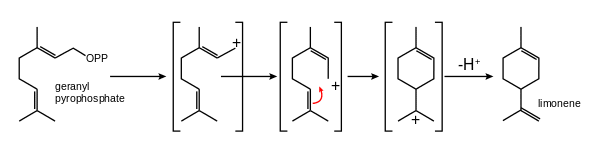
Biosynthesis
Indeed, it is formed from geranyl pyrophosphate through the cyclization of a neryl carbocation or its equivalent. Here is a representation of this biosynthesis.
Health considerations
As with any molecule or chemical component, it's always important to consider its health implications. That being said, we note that, overall, this terpene is not dangerous. How can this be explained? In fact, it's used in the food and pharmaceutical industries to flavor food and medications. Similarly, some cleaning products use it for its refreshing scent.
However, long-term use in cleaning products may have side effects in some people, particularly skin irritation.
Regarding toxicity cases: Limonene has been fully approved as a safe food additive and flavoring by the Food and Drug Administration since 1994! When evaluating the compound's toxicity, they found that it had " relatively low acute oral toxicity ."
This terpene, limonene, is naturally present in CBD flowers.
Also read about CBD.

Co-founder of CBD.fr
Julien Cordobes is the editor of CBD.fr. Born in 1978 in the Paris region, he first trained in e-commerce before turning to natural health approaches, a dual perspective that now structures his way of writing about cannabidiol: reading the scientific literature as it is, without hardening the conclusions, and presenting it in a language that everyone understands.
He discovered CBD at a time when the French market was developing faster than the information available to it. He acquired CBD.fr in 2022 and then took on editorial responsibility for the blog. Since then, he has published numerous articles covering the daily use of CBD, the interpretation of laboratory analyses, the evolution of the legal framework, and precautions for use.


